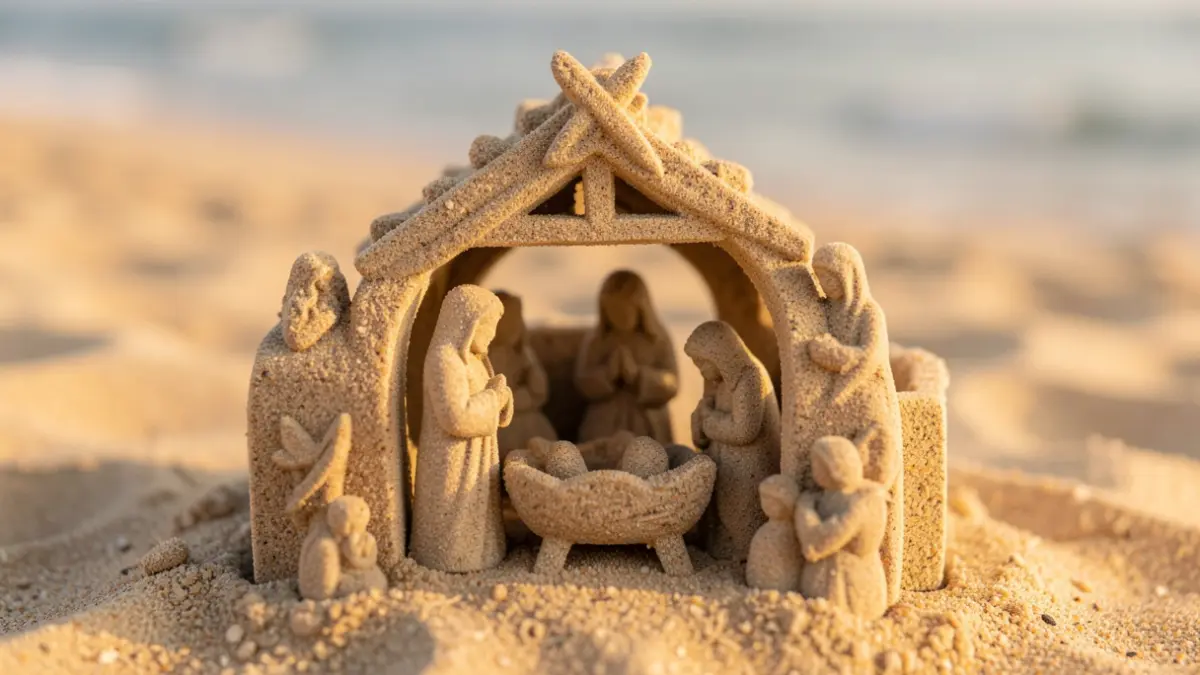
Pedro Quevedo, Councilor for Tourism of the Las Palmas de Gran Canaria City Council and president of the municipal company Turismo LPA, was emphatic regarding the announced cancellation of the Sand Nativity scene at Las Canteras by its promoting company, Go Beyond. Quevedo stated that the decision "responds to an attempt by Go Beyond to extort public administration, taking advantage of the upcoming electoral call." He added that the cancellation notice, received on November 9th, was made "in bad faith" by not allowing sufficient reaction time.
The head of Tourism reviewed the chronology of the file, highlighting the economic inconsistencies detected in the documentation submitted by the organizing entity. While the sponsorship request to the City Council, dated September 21st, placed the total cost of the Nativity scene at 490,000 euros, the financial study sent to Costas on October 13th put the total cost at 309,730.60 euros. Quevedo described this difference of "about 180,000 euros for the same concept" as "unacceptable for a public body."
Quevedo clarified that the 200,000 euros requested by Go Beyond represent an approximate increase of 180% compared to the funding received in the last edition (77,221.90 euros), plus approximately 10,000 euros for promotion and marketing contributed by Turismo LPA. "It is not reasonable from the perspective of defending and efficiently using municipal resources, especially when we do not see improvements in the project that justify this increase in public contribution," he stated.
The councilor recalled the historical financial support that the City Council and Turismo LPA have provided to the project since its inception two decades ago. He detailed that in 2006 the contribution was 107,000 euros, and in 2008 a shared financing model was consolidated with other administrations and private sponsors, with the city council's contribution reduced to 53,500 euros. The budget increased progressively, reaching 77,221.90 euros in 2025, plus 10,000 euros for promotion and advertising.
Quevedo reiterated the need to be "rigorous and transparent with the management of public resources," expressing confidence that the sum of the updated contributions from Turismo LPA, the support from other public administrations and private entities, would have been "more than sufficient." He added that "even the 300,000 euros that appear in the financial report sent to Costas are difficult to justify."
Finally, Quevedo confirmed that Turismo LPA "will not abandon the soup kitchens" and will increase aid to the five social soup kitchens in the capital, allocating 6,000 euros to each before Christmas, to prevent the event's cancellation from harming their work.