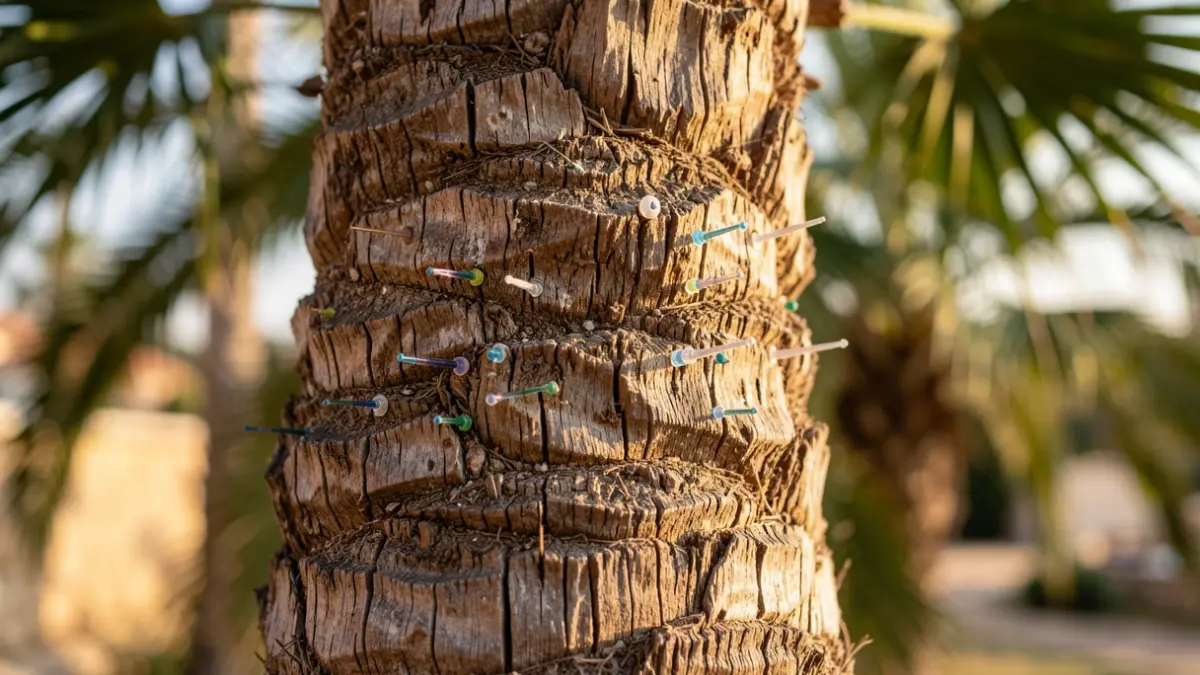
Over the next month, the Parks and Gardens department will treat a total of 282 palm trees with the insecticide Revive II, applied via endotherapy, which protects the specimens for at least 24 months against the 'diocalandra'.
The product, whose active ingredient is emamectin benzoate, is injected into the trunk and distributed through the vascular system, reaching the beetle that creates channels acting as entry points for pathogenic fungi. The 'diocalandra' pest affects a high percentage of palm trees on the islands, endangering their survival.
"We have brought to the table the problem that the 'diocalandra' plague poses to our palm trees, not only in the municipality of Las Palmas de Gran Canaria but in practically all the islands. We seek the collaboration of other administrations but cannot afford their timelines, so we are doing our part. More reviews, improvements in soil conditions, and now the most effective treatment known, which adds to what we were already applying. It's about maximizing our commitment to our green heritage until the Government of the Canary Islands takes this widespread plague seriously," indicated Gemma Martínez Soliño, Councilor for Strategic Development, Sustainability, Energy, Parks and Gardens, and Primary Sector.
The application, which began this week after a training session at Parque Romano, will focus in a first phase until December 16th. Priority will be given to singular or long-lived specimens, high-traffic areas, and locations with a higher incidence of the pest. Areas to be treated include Ciudad Jardín, Parque San Telmo, Parque Santa Catalina, Parque Sixto Henríquez, Parque de Buenavista, Schamann, the Castillo de La Luz Park, Primero de Mayo street, and Plaza Santa Ana.
The insecticide, marketed by Syngenta, is registered in Spain for treating various palm tree pests and is backed by studies from the Canary Institute of Agricultural Research (ICIA) and GMR Canarias. Application via endotherapy minimizes risks to people and pets.
This treatment is part of the Urban Tree Shock Plan, implemented since 2025 to improve the inspection and risk prevention for trees and palm trees. In 2025, 327 palm trees and 54 ficus trees were treated, and so far in 2026, 220 specimens, with notable results against the Psila pest in ficus trees and a reduction in 'diocalandra' on palm trees.