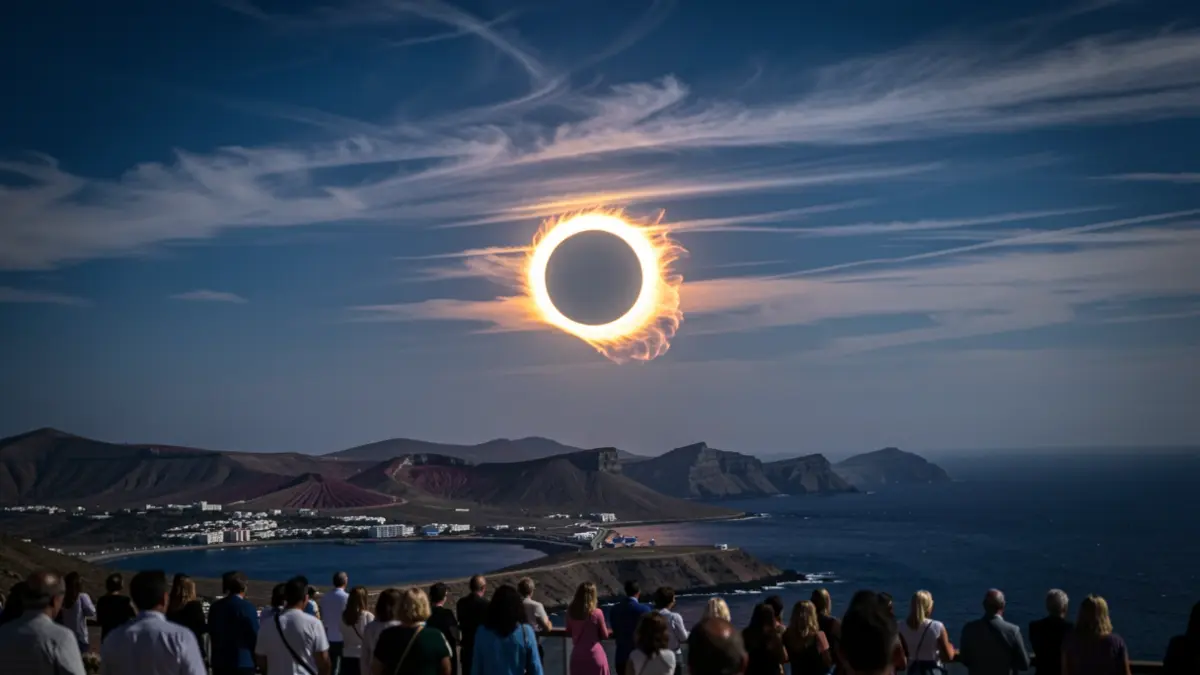
Following the solar eclipse on August 12, which provided memorable images in the Canary Islands, the Archipelago will not have to wait long to enjoy celestial events again. The next two years will bring two new opportunities to observe solar eclipses, with dates marked on the calendar for 2027 and 2028.
These events are part of what has been termed the 'eclipse trio' of 2026, 2027, and 2028. The next stop will be on August 2, 2027, followed by another event just six months later, on January 26, 2028. Both dates have been confirmed by the National Geographic Institute (IGN) as major solar eclipses visible from Spain.
On August 2, 2027, a total solar eclipse will occur. Although totality will cross the south of the Iberian Peninsula, Ceuta, and Melilla, it will be observed as a partial eclipse in the Canary Islands. Unlike the August 2026 event, which happened at sunset with the sun low on the horizon, the 2027 eclipse will take place in the morning, offering much more favorable observation conditions, as highlighted by the IGN.
The Canary Islands, while outside the path of totality, will experience a particularly deep eclipse. The European Space Agency (ESA) estimates darkness percentages between approximately 76% and 82%, depending on the island. In Las Palmas de Gran Canaria, for instance, the partial eclipse will begin around 8:33 AM, reach its maximum at 9:34 AM, and end around 10:42 AM, covering about 77% of the solar disk.
The 2027 eclipse is considered one of the major astronomical phenomena of the century on a global scale, with a totality phase in Egypt reaching an exceptional duration of 6 minutes and 23 seconds.
Just six months later, on Wednesday, January 26, 2028, an annular solar eclipse will occur. In this type of eclipse, the Moon does not completely cover the solar disk, creating the well-known 'ring of fire'. While this ring will be visible in parts of Spain and Portugal, the Canary Islands will observe it partially, though with considerable occultation, especially in the western islands, where the magnitude may approach 0.9 in the province of Santa Cruz de Tenerife.
The phenomenon will begin in the Canary Islands around 3:15 PM and end shortly after 6:00 PM, with slight time variations between islands. These events extend an extraordinary period for astronomy enthusiasts in the islands.
The Canary Islands have a long history with these phenomena, recalling the total eclipse of October 2, 1959, which attracted significant scientific interest. Now, more than six decades later, the Archipelago is experiencing an intense period with three major solar eclipses between August 2026 and January 2028.
The safety recommendation for the upcoming phenomena will remain the same: it is essential to use adequate protection, such as specialized solar filter glasses, to observe the sun during the partial phases of an eclipse. The IGN warns that direct observation without protection can cause serious eye injuries.