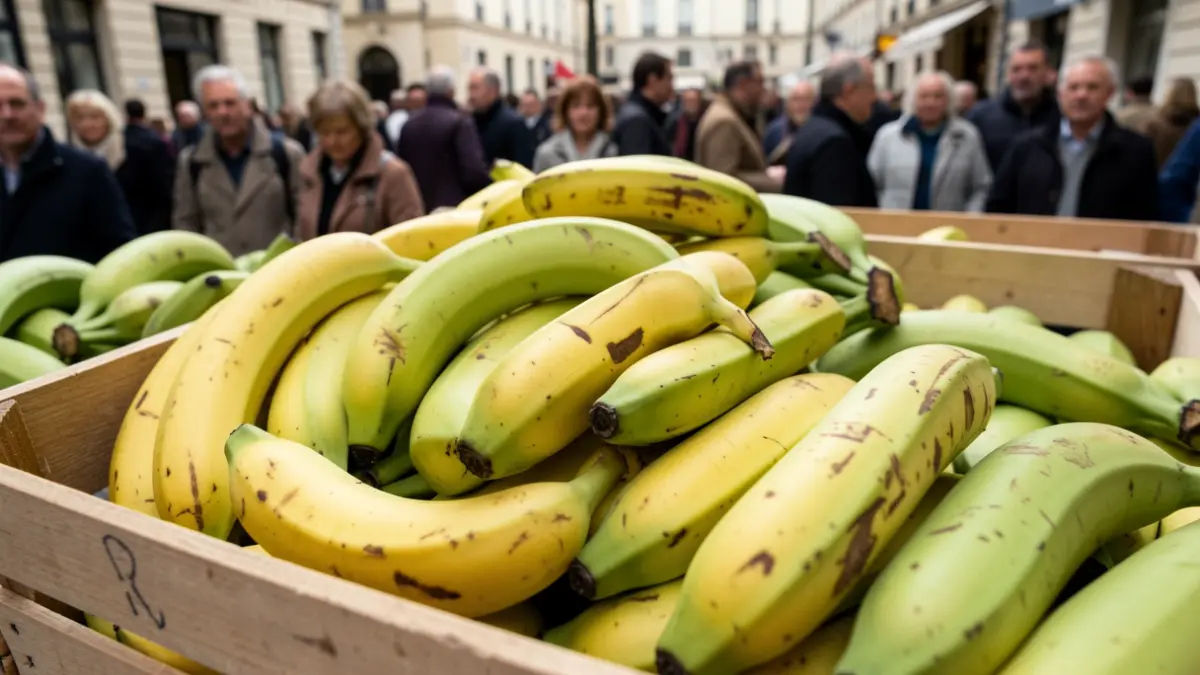
The primary market for Canary bananas, mainland Spain and the Balearic Islands, which receives over 90% of the total production, is in a critical state. Factors such as extreme heat, excessive harvesting or supply on the islands, a lack of effective measures to balance supply and demand, extreme dependence on the national market, and a decline in summer consumption, coupled with the increasingly strong competition from bananas, are significantly impacting the profitability of this emblematic fruit.
During week 29 (July 13-19), the farm-gate price for superior quality fruit stood at 0.41 euros per kilo, representing a 19.55% drop compared to the previous week. This new collapse brings the final income for the Canarian farmer to 0.41 euros per kilo, 0.10 euros less than in week 28 (0.51 euros).
With these final prices, and after deducting on-farm production costs (ranging between 0.70 and 0.80 euros per kilo), the losses are substantial. Sales are clearly not remunerative, and the difficulty in making a profit from banana cultivation, even with the EU's direct aid (a maximum of 0.34 euros per kilo), is increasing, particularly during the summer months.
This market situation, which could become a structural scenario for summers, is causing significant concern. Potential solutions, which should originate from the organization Asprocan, are either not emerging or, in the worst case, do not exist.
The farm-gate price of 0.41 euros per kilo in week 29 of this year is almost identical to that obtained in the same period of 2023 (0.42 euros per kilo), which was considered the worst campaign for local producers in the last six years. In 2023, summer prices ranged between 0.20 and 0.25 euros per kilo in late August, and in 2025, the average value paid to farmers was around 0.40 euros per kilo, also during the summer.
According to information gathered from producer sector sources in the Canary Islands, the planned shipment volume to mainland Spain for week 31 (July 27 to August 2) remains similar to weeks 28, 29, and 30, around 5.5 million kilos. The only relief in supply comes from shipments to neighboring Morocco.