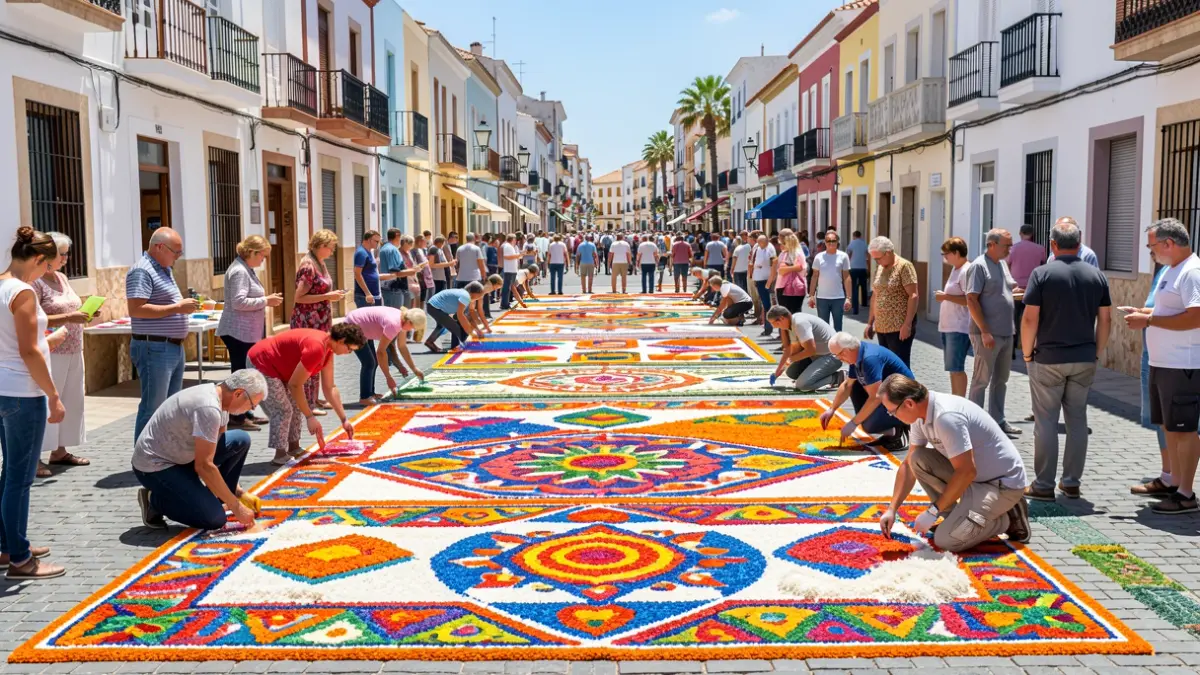
The elaboration of the ephemeral designs, which decorated the route of the procession of the Sacred Heart of Jesus, saw the participation of numerous residents, strengthening community ties and preserving a custom passed down through generations.
The city's mayor, Carolina Darias, was present at the event, accompanied by the councilor for the Isleta-Puerto-Guanarteme District, Héctor Alemán, who shared the activity with the neighborhood's residents.
This tradition, with over seven decades of history, originated in the late 1940s using sawdust. Over time, it evolved into the current salt carpets, becoming a symbol of the La Minilla Baja festivities.
The preparation and coordination for each edition require hours of work, with participants designing compositions in various colors that cover parts of the streets through which the procession later passes.
The Las Palmas de Gran Canaria City Council collaborated in the initiative by supplying the salt, through the corresponding municipal district. Councilor Héctor Alemán highlighted the role of these neighborhood festivals as spaces for meeting and social cohesion.
Mayor Carolina Darias emphasized the importance of preserving these popular traditions as part of the cultural and identity heritage of the neighborhoods of the Gran Canaria capital, valuing the commitment of those who keep the custom alive.
The creation of salt carpets is one of the central events of the La Minilla Baja festivities, which have also included activities such as the neighborhood night to foster participation and coexistence.