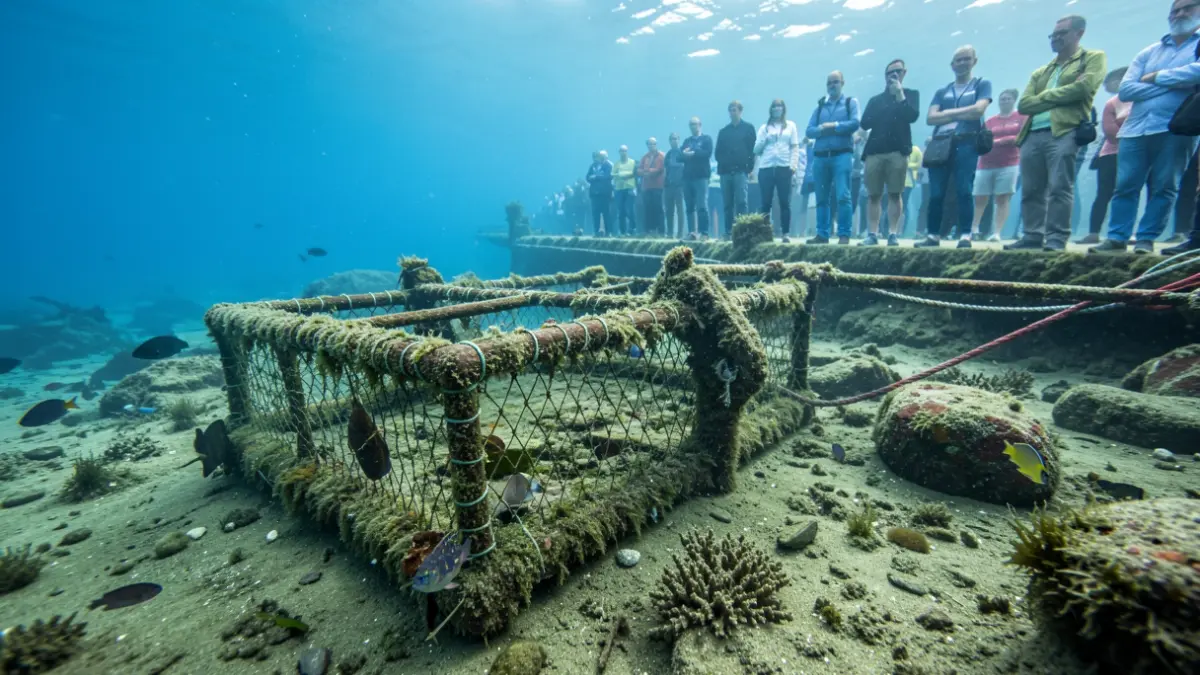
A report from the Canary Islands Government's Autonomous Environmental Evaluation Commission (CAEA) raises concerns about the impact of 24 marine cages planned off the coasts of La Aldea de San Nicolás and Artenara. These facilities are expected to discharge around 740 tons of feces and waste annually into the seabed, risking "significant ecological disruptions".
The future fish farm, intended to house up to 5.5 million sea bass per year and consume approximately 850,000 kilograms of feed monthly, would be located in oligotrophic waters, which are nutrient-poor. Regional Executive technicians warn that this massive influx of organic matter would disrupt the delicate ecological balance, affecting both the water column and the seabed.
The document also notes that the accumulation of waste, combined with rising water temperatures due to climate change (exceeding 24 degrees Celsius), could promote mass proliferation of the marine cyanobacteria Lyngbya majuscala. This bacterium produces toxins that can cause respiratory, ocular, and skin irritations in humans and can be fatal to birds and turtles.
The CAEA emphasizes that a fish farm's location is crucial for its impact. The most suitable sites are those far from the coast, with greater depth and strong currents. However, the report indicates that the proposed location on the northern coast of Gran Canaria does not meet these criteria, being only 840 meters from the shore and close to protected areas like the ZEPA and the ZEC ‘Sebadales de GüíGüí’.
Studies by the developer, Gran Canaria Bass Company SL, a subsidiary of a company based in the United Arab Emirates, acknowledge that currents could carry particles to the coast, affecting algae communities on rocky seabeds. Furthermore, eight of the 24 cages would be located at depths less than 40 meters, violating Article 39 of the Regional Aquaculture Plan (PROAC), which requires a minimum depth of twice the net's draft (20 meters).
The area designated for the fish farm is classified as a Priority Use Zone for Biodiversity Protection (ZUPPB), although it overlaps with the High Potential Aquaculture Zone (ZAPAC). The large-scale farm would impact sandy bottoms colonized by garden eels and habitats of Community Interest, as well as the presence of the angel shark, an endangered species.
The Island Council of Gran Canaria also warns of a "significant impact" on the brown algae (yellow seaweed), classified as vulnerable, and other vulnerable algae like Gelidium canariense. The shadow cast by the cages and mooring lines would affect these species in a "non-punctual, temporary, and reversible" manner.
The CAEA warns of a real risk of "supermassive escape" of farmed fish due to severe marine storms in the area. These escaped sea bass could prey on other species of fishing interest, such as juvenile bogas or old wives. Between 1998 and 2009, 16 massive escapes were recorded in the Canary Islands, and in 2010, 90% of fish escaped from a farm in La Palma.
Given these impacts, the CAEA deems that the project requires an ordinary environmental impact assessment, the most exhaustive procedure, due to its potential for "significant effects on the environment." This process is ongoing and could take years.
Organizations such as Greenpeace, the Platform for a Clean Sea, and artisanal fishermen have raised alarms about the plans of Gran Canaria Bass Company SL, a subsidiary of SSB Holding, which seeks to expand into other countries and develop projects in Lanzarote and Tenerife.
The PSOE of La Aldea has called for transparency and the release of conclusions from a municipal study on fishing and aquaculture development. Activists like Vanessa Santana from Greenpeace report "broad rejection" from the local population, who fear negative impacts on traditional fishing, the logistics dock, and the natural environment of GüíGüí.