The President of the Canary Islands, Fernando Clavijo, along with the Minister of Agriculture, Narvay Quintero, and the Mayor of La Frontera, Pablo Rodríguez Cejas, presented the 4th Pineapple Fair and the Training Workshops dedicated to this product. The event, to be held on July 17th and 18th in the Herreño municipality, aims to continue boosting one of the island's most emblematic products.
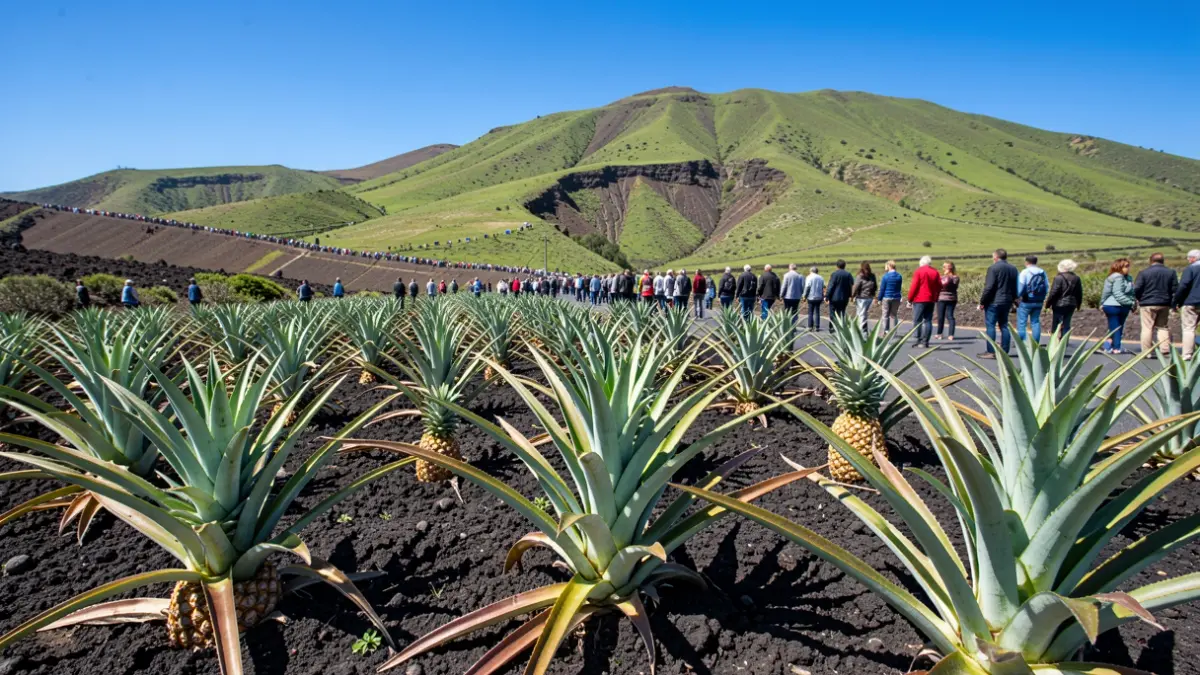
The head of the Canarian Executive highlighted the socioeconomic and identity importance of tropical pineapple, a strategic crop particularly linked to the Valle de El Golfo. Clavijo reviewed the measures implemented by the regional administration, in collaboration with the City Council, the Island Council (Cabildo), and producers, to revive its production, which has been affected by pests and diseases in recent years.
Clavijo reaffirmed the regional Executive's commitment to the recovery of tropical pineapple, emphasizing its contribution to the island's economy and employment, as well as its close connection to the landscape, history, and Herreño identity. The presentation was also attended by the first deputy mayor of La Frontera, Marcos Barrera; the president of SAT Frutas de El Hierro, Pablo Carmona; the president of the Insular Cooperative of the Field of La Frontera, Miguel Ángel Padrón; and the deputy of the Parliament of the Canary Islands for the Herreño Independent Group (AHI), Raúl Acosta.
The President indicated that both initiatives, the fair and the training workshops, represent an opportunity to recognize the work of producers, promote the consumption of pineapple from El Hierro, and highlight the actions taken to recover the crop's productive capacity. "Tropical pineapple is much more than a high-quality agricultural product. It is a fundamental activity for numerous families, it is part of the landscape of the Valle de El Golfo, and it is one of the most representative products of El Hierro," stated Clavijo.
The Government of the Canary Islands maintains a stable and coordinated line of work to guarantee the future of the crop, supporting farmers with resources, scientific knowledge, and technical assistance. These efforts have involved an investment of over 1.4 million euros by the regional Executive during this term, within the framework of the General Protocol of Action for the recovery of tropical pineapple production in El Hierro.
Key measures include the production of 75,000 plants of Spanish Red tropical pineapple propagated in vitro, intended for farmers and for consolidating mother plant fields. In parallel, the Canarian Institute of Agrarian Research (ICIA) and the Plant Health Service are investigating the factors causing yield loss, focusing on wilting and control of the cotton mealybug, as well as improving soil management and disinfection.
These actions are complemented by financial support to the Campo de Frontera Cooperative Society and SAT Frutas de El Hierro, amounting to 444,886 euros, the exceptional authorization of soil disinfection products, and support for research and innovation projects like GO-Trazcan. Furthermore, the POSEI program will incorporate, for the 2026 campaign, a minimum aid per hectare for this local production.
The 4th Pineapple Fair, organized by the La Frontera City Council with the support of the Government of the Canary Islands and the collaboration of the Island Council and local producers, will offer on Saturday, July 18th, an open program featuring exhibitions and direct sales, tastings, culinary demonstrations, workshops, and children's activities.
Mayor Pablo Rodríguez Cejas highlighted La Frontera's connection to tropical pineapple, a result of the vision and effort of its farmers. "This event allows us to promote, value, and showcase a product that has become a true hallmark and a brand of La Frontera and El Hierro," he stated.
Minister Narvay Quintero added that technical work must be accompanied by training, promotion, and commercialization. The workshops and the fair align with this comprehensive vision, aiming to improve cultivation, share knowledge, bring the product closer to consumers, and explore gastronomic and tourism opportunities.
Industry representatives such as Pablo Carmona and Miguel Ángel Padrón expressed concern over the decline in pineapple production but showed optimism regarding the ongoing recovery projects. President Clavijo concluded that supporting tropical pineapple means backing the farmers of El Hierro, preserving its productive landscape, and ensuring the future of a crop linked to the island's identity.
The fair's proposals include a cocktail workshop, a show cooking event with wine pairings from La Frontera, healthy cooking activities, a children's sensory tasting, and an exhibition on the history and characteristics of El Hierro's pineapple. The initiative aims to place producers at the center, encourage local consumption, and strengthen its presence in restaurants, shops, homes, and the island's tourism offerings.
As a prelude, the Pineapple Training Workshops will be held on Friday, July 17th, as part of the Dinamiza Rural program of the regional Executive. These workshops will bring together producers, technicians, catering and nutrition professionals, and the public to enhance product knowledge, promote its gastronomic use, and explore new avenues for commercialization and diversification.