The work, carried out under an agreement between the Cabildos of Fuerteventura and Tenerife, focused on three areas and documented a space linked to lime processing. The multi-year project is co-directed by Isidoro Hernández Sánchez, Mercedes del Arco Aguilar, and María del Carmen del Arco Aguilar, and includes specialists from the University of La Laguna and the Museum of Natural Sciences of Tenerife.
The Minister of Historical Heritage, Rayco León, highlighted that "Lobos continues to demonstrate that the islet holds much more than meets the eye. This campaign adds a workspace linked to lime and opens new questions that can only be answered with further work and excavations." He emphasized the project's continuity to "complete the history of the islet".
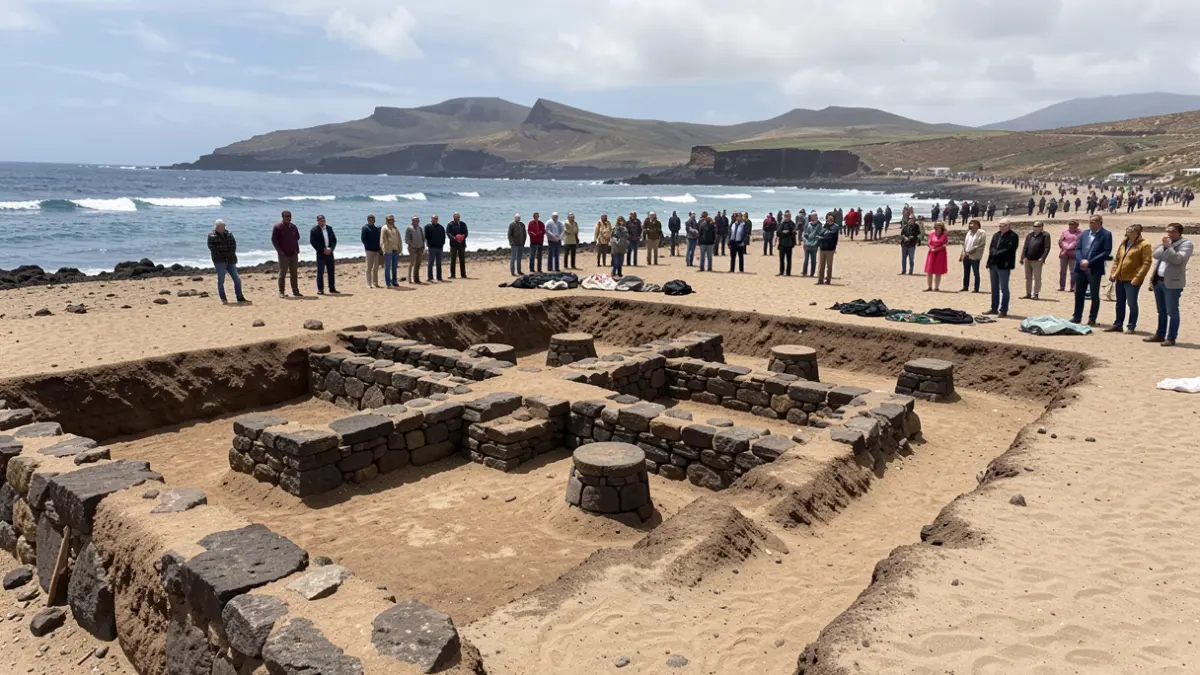
Archaeologists first investigated a presumed lime kiln that had collapsed and was covered in sand. The excavation, covering approximately 98 square meters, defined a kiln without external buttresses and with a central circular body. No archaeological materials that could associate it with a specific culture were found in the collapse deposit.
In a second area, a combustion structure and a lime crust were identified, possibly corresponding to kiln cleanings. The third area revealed a deposit of stones, some aligned, potentially forming the base of a wall, along with a circular space and a triangular stone element. The interpretation of these structures remains open pending further excavation.
The team believes that the Romans settled in Lobos needed lime for the mortars of the purple dye workshop at Lobos 1 and for obtaining the dye. The kiln exhibits unique construction features that might aid in dating it, although a more recent historical period is not ruled out. Dating of the lime crust and combustion remains will help specify its last period of use.
The heritage value of the kiln and adjacent areas is considered "unquestionable." Nearby areas have also yielded evidence of human activity, such as malacological material and pottery, which will be studied in future excavations, thus enhancing the cultural heritage of La Calera Beach.