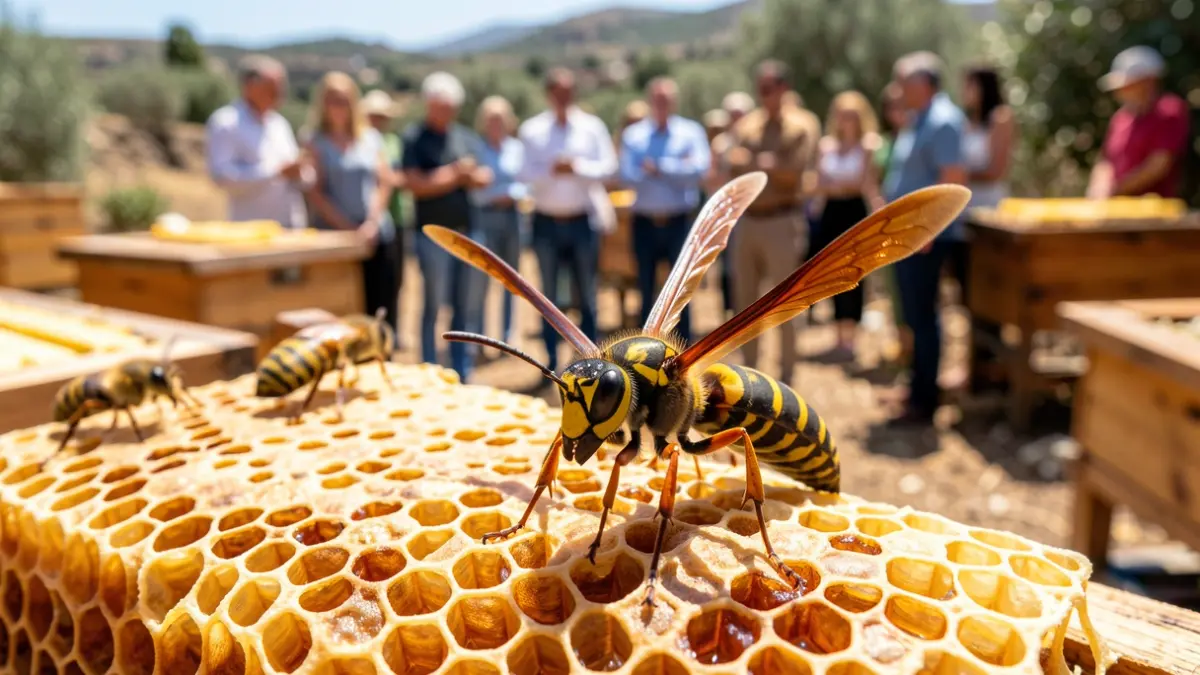
The news of the presence of the Asian hornet (Vespa velutina ssp. nigrithorax) in the capital of Gran Canaria has generated deep concern within the beekeeping community of Gran Canaria. This finding, the first in the Canary Islands, marks a worrying turning point, as this invasive species primarily targets honeybees.
Antonio Quesada, a member of the Gran Canaria Beekeepers Association, described the situation as "one of the most serious alarms" for the sector. The collective had already been watching the hornet's expansion on the mainland since 2010 with apprehension, aware that its arrival in the archipelago was a matter of time, given its close ties to maritime transport and goods.
The Asian hornet is known for its voracity towards bees, to the point of "making entire apiaries disappear," resulting in "very serious economic consequences" not only for beekeeping but also for the rich Canarian biodiversity. Quesada recalled that the Canary Islands host a high density of bee species, with 146 identified, many of them endemic, in addition to over 73 species of solitary bees in Gran Canaria, which occupy very specific ecological niches.
The proliferation of the Asian hornet could "wipe out these species," causing "tremendous damage" to the island ecosystems. The pollination role performed by bees is fundamental for the reproduction of wild plants and agricultural crops, with their benefit to agriculture being "greater than what the beekeeper directly receives." The decline in biodiversity in sensitive island environments like the Canary Islands exacerbates the problem.
Furthermore, the presence of these hornets alters the natural behavior of bees, forcing them to remain inside the hives for protection, which often leads to starvation. However, the fact that the detected nest was found in an urban environment like the island's capital offers some hope, as it is considered that "it will be possible to eradicate it" if contained within the urban area. A call for citizen collaboration has been made, but with a warning not to handle nests or traps without proper knowledge.
The Gran Canaria Beekeepers Association participates in the Early Warning Network for Invasive Exotic Species of the Government of the Canary Islands (RedEXOS). While they appreciate the swift action by the organization and the relevant department in placing detection traps, Quesada regrets the lack of contact from the Ministry of Agriculture, especially since the "remedies" to combat this pest are "very costly" and the "economic disaster is very great."
Beekeeping represents a source of income for approximately 340 families in Gran Canaria, who manage around 10,000 hives. Across the entire archipelago, the figure rises to 1,250 beekeepers working with about 32,000 to 35,000 hives.