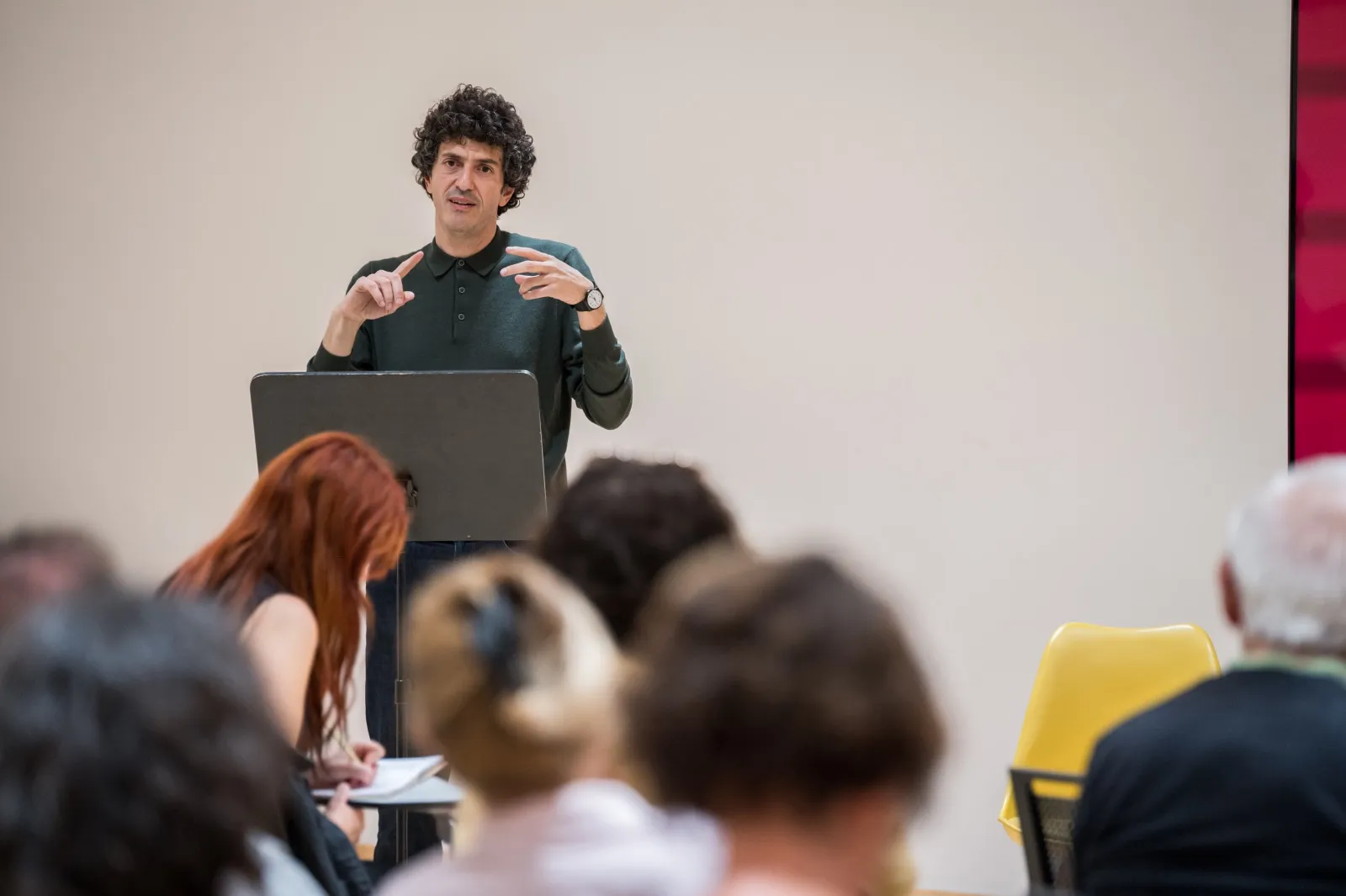
Architect and Doctor of Social Sciences, Chema Segovia, and fellow architect Vicente Díaz, were the protagonists of the third session in the conference series 'Who Owns the City? Culture, Power, and Urban Disputes', held on November 12th at the Sala Cuarterías of the Cuyás Theatre. The Chair of Culture and Territorial Development of the University of Las Palmas de Gran Canaria, with the support of the Department of Culture of the Cabildo de Gran Canaria, organizes this series of public lectures to analyze contemporary urban tensions.
Segovia, author of a study on the neighborhood's development, delivered the talk 'Local Development through Culture', a title shared with his book. In his presentation, he emphasized Guanarteme's distinctive identity as a premise for its resilience against unchecked urban development, stating that it "has extremely important social and cultural value for the city."
Vicente Díaz, a specialist in the La Isleta neighborhood, introduced Segovia and stressed the importance of "sharing knowledge." Díaz commented on the city's expansion following the creation of the Port, which affected La Isleta and Guanarteme, and noted that "fortunately, urbanism is not infallible," citing Secundino Zuazo's failed plan to "close off Las Canteras at Playa Chica, all the way to La Isleta."
Díaz defined the city as a "game board" with political actors, institutions, technical specialists, and citizens. He reflected on issues such as sidewalk height or the placement of pedestrian crossings, concluding that the "game" proposed in Segovia's book is "to put culture at the center," succeeding in its diagnosis and offering valid strategies for other neighborhoods.
José Manuel Segovia Collado, a professor at the Open University of Catalonia (UOC) and collaborator with Econcult, explained that his book is a proposal to "reconfigure urbanism by introducing culture as a structuring element" and to rethink cultural policies. "I am convinced that the ways we think about the city must be re-examined," he confessed, because, in a broad sense, "today, culture is a lost element within urbanism."
Segovia highlighted the dualities of Las Palmas de Gran Canaria, such as the difference between the lower and upper city, or Triana and Vegueta versus the Port area. He located Guanarteme's origins a few years before the "discovery of the city's other coastline, in 1940, when the Las Canteras promenade began to be developed." He described it as a working-class neighborhood because the land, belonging to the municipality of San Lorenzo, was very cheap. He mentioned the unbuilt plan for a satellite town with a church, school, and theater.
The architect noted that Guanarteme "has always seen the city encroach upon it" but has shown "a certain positive resilience, integrating things that happened and making them its own, without losing its identity, as happened with the arrival of surfing." He described it as "a perfect example of a multi-layered neighborhood that grows without ceasing to be itself."
However, the new urban planning of the 21st century considered the area to have no value, which has generated a "very strong impact." To reverse these effects, Segovia proposes that "Guanarteme is a neighborhood of extremely high value for Las Palmas de Gran Canaria, with a history connected to the city and its relationship with the sea."
His field research revealed a "large presence of liberal professionals, workers linked to arts and creativity, with much new population but also many consolidated residents." Guanarteme is, in short, "a vibrant neighborhood, with its festivals, its traditions, with a great cultural depth." Its example is "extrapolable" to other urban environments.
The 'Who Owns the City?' series will continue until December 10th at the Sala Cuarterías of the Cuyás Theatre at 7:30 PM. The next conference, on November 24th, will focus on 'Tenant Generation' with Javier Gil and Sandra Navarro-Mayoral. The series will conclude on December 10th with 'The City as Interface', featuring Ingrid Guardiola, presented by Sara López.