The Canarian Health Service (SCS), along with the Canary Islands Health Research Institute and the Canary Islands Health Research Institute Foundation, is promoting the Cohorte IMPaCT study in La Palma. This epidemiological research initiative, a leading one in primary care and precision medicine, has already recruited 570 participants on the island as of September this year.
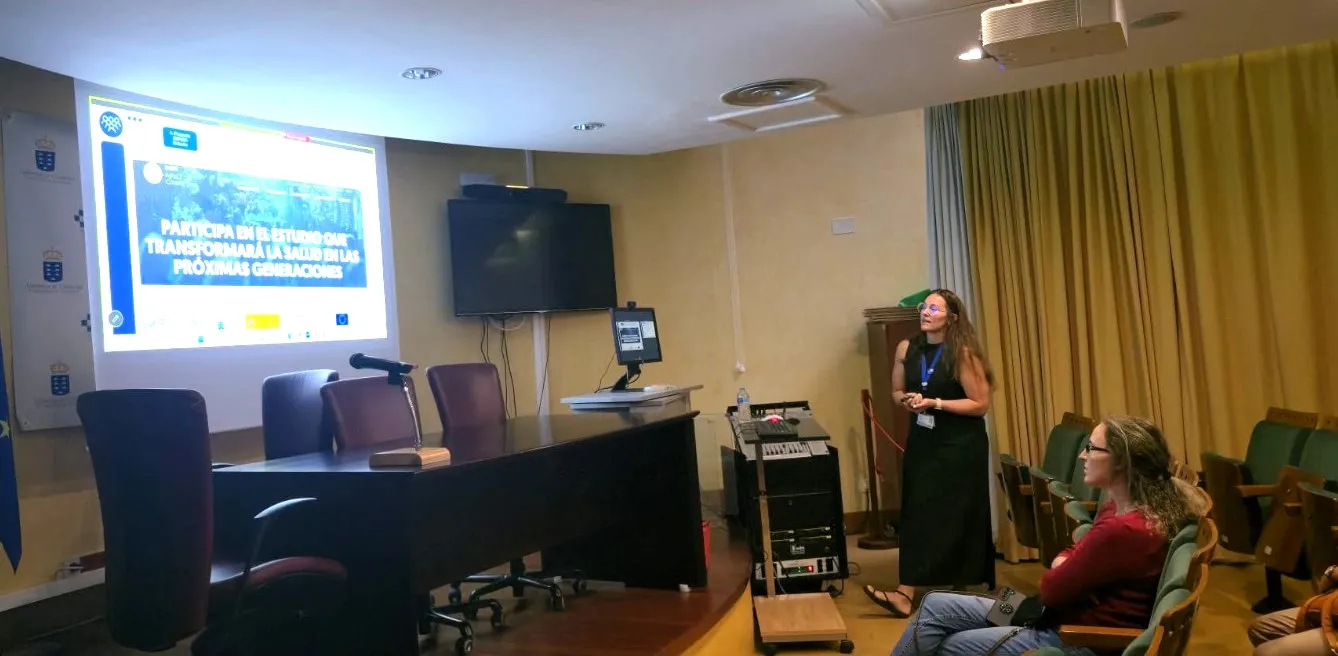
The Management of Health Services of the La Palma Health Area organized a training session at the University Hospital of La Palma to monitor the study's development. The session, led by the technical coordinator of IMPaCT Cohorte, Pilar Chantada, and the person responsible for implementation on the island, Náyade Jorge, aimed to introduce the project to health professionals in the area.
Cohorte IMPaCT, under the slogan ‘If they call you, come!’, is part of the Predictive Medicine Program and seeks to better understand how people live and what factors influence their health over time. Nationally, 51 nodes have been established across the 17 autonomous communities, randomly inviting individuals from specific basic health zones to participate.
In the Canary Islands, the study has three nodes: Tenerife, Gran Canaria, and La Palma. The La Palma node, located at the Los Llanos Health Center and the CAE, covers the basic health zones of Los Llanos de Aridane, Santa Cruz de La Palma, Breña Alta, Breña Baja, El Paso, Tazacorte, and Tijarafe. The plan is to randomly select 4,000 individuals from these population centers over the twenty years of the research.
To date, out of the 570 participants in La Palma, 57.19% are women and 42.81% are men. Regarding age groups, 24.54% of women are between 40 and 50 years old, and 31.15% of men are between 50 and 60 years old.
Promoted in the Canary Islands by the SCS, the Canary Islands Health Research Institute, and the Canaria IISC/FIISC Foundation, the study is supported by Spanish Government ministries, the Government of the Canary Islands, the Carlos III Health Institute, CIBER, and the European Union. Nationally, the participation of 200,000 individuals aged 16 to 79 is anticipated.
Selected participants who voluntarily agree to join will provide information through epidemiological questionnaires on aspects such as lifestyle habits or environmental exposure. Additionally, they will undergo various health-related tests and measurements, including audiometry and spirometry. They will also be part of the European project 'More than a million genomes'.
All this information will enable research teams to study the health evolution of participants and identify factors related to various diseases and health problems. The ultimate goal is to contribute to improving prevention, healthcare, and the design of Public Health policies.