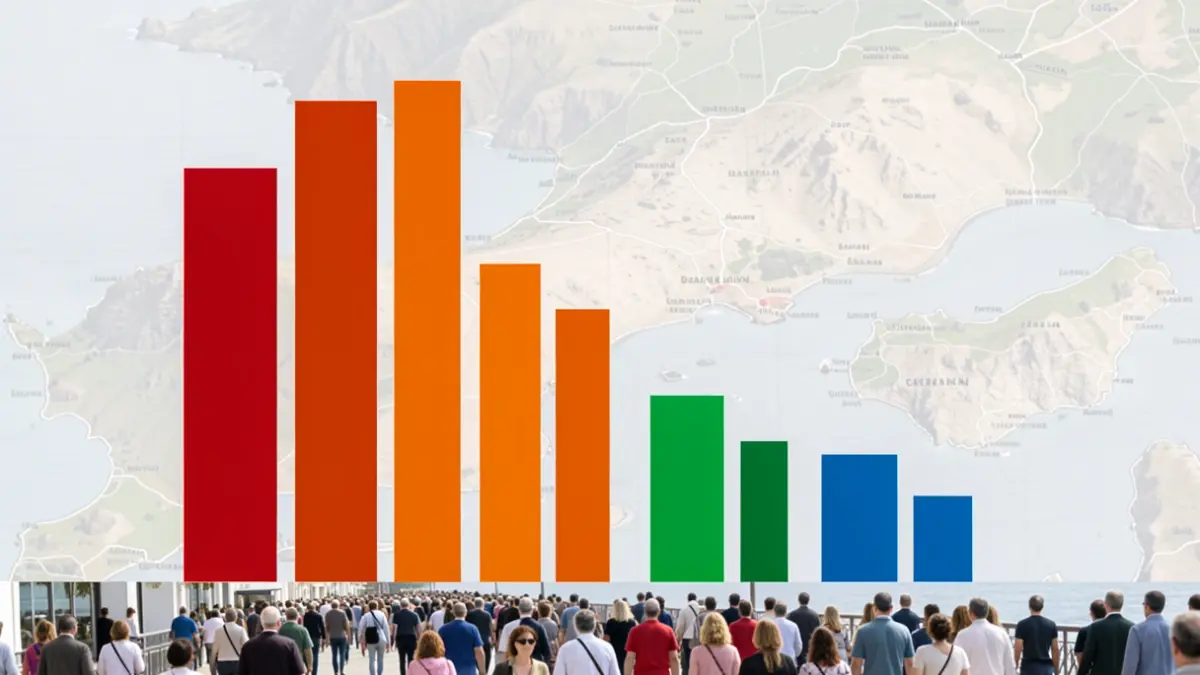
The third quarter of 2026 has revealed significant disparities in registered unemployment rates across the Canary Islands. Neighborhoods like La Alegría, Barrio Nuevo, and San Pío X in Santa Cruz de Tenerife, along with Jinámar and El Lasso in Las Palmas de Gran Canaria, lead with rates exceeding 25%.
In contrast, neighborhoods with the lowest unemployment rates include El Cable (1.6%) and La Concha (3.2%) in Arrecife; Ciudad del Mar (6.1%) and La Minilla (5.5%) in Las Palmas de Gran Canaria; Playa de las Américas (6.6%) and Chayofa (6.8%) in Arona; and Las Mimosas (4.6%) and Los Hoteles (5.7%) in Santa Cruz de Tenerife.
This data comes from the Active Population Survey (EPA-Reg), published by the Canary Islands Institute of Statistics (ISTAC) in collaboration with the Canary Islands Employment Service. The EPA-Reg uses integrated administrative records to provide territorially disaggregated data, even at a sub-municipal level, for the municipalities of Santa Cruz de Tenerife, Las Palmas de Gran Canaria, Arrecife, and Arona.
At the municipal level, Yaiza and Pájara (Lanzarote and Fuerteventura, respectively) continue to show the lowest registered unemployment rates, both below 9%. La Gomera has fallen below 10% unemployment, with Alajeró (6.8%) among the five municipalities with the lowest rates, alongside Yaiza (5.5%), Pájara (5.7%), Tías (6.7%), and Teguise (6.9%).
On the other hand, La Palma (14.5%) and Gran Canaria (14%) record the highest unemployment rates at the island level. The municipalities with the highest rates are Garafía (22.5%), Tazacorte (19.4%), Agaete (18.2%), Moya (18.1), and La Victoria de Acentejo (16.6%).
Registered unemployment rates for women are higher than for men across the territory, except in El Hierro, where they are nearly equal. The largest differences are observed in Gran Canaria (4.4 percentage points), La Palma (4.3), and Tenerife (4.1).
In year-on-year comparison, the number of registered employed persons has increased on all islands, with an average growth of 3.3% in the Canary Islands. Fuerteventura and Lanzarote lead this growth with 5.4%, while La Palma shows the smallest increase (1.3%). Registered unemployment has decreased by 3.8% overall, although it has risen in El Hierro (6%) and La Palma (1%).