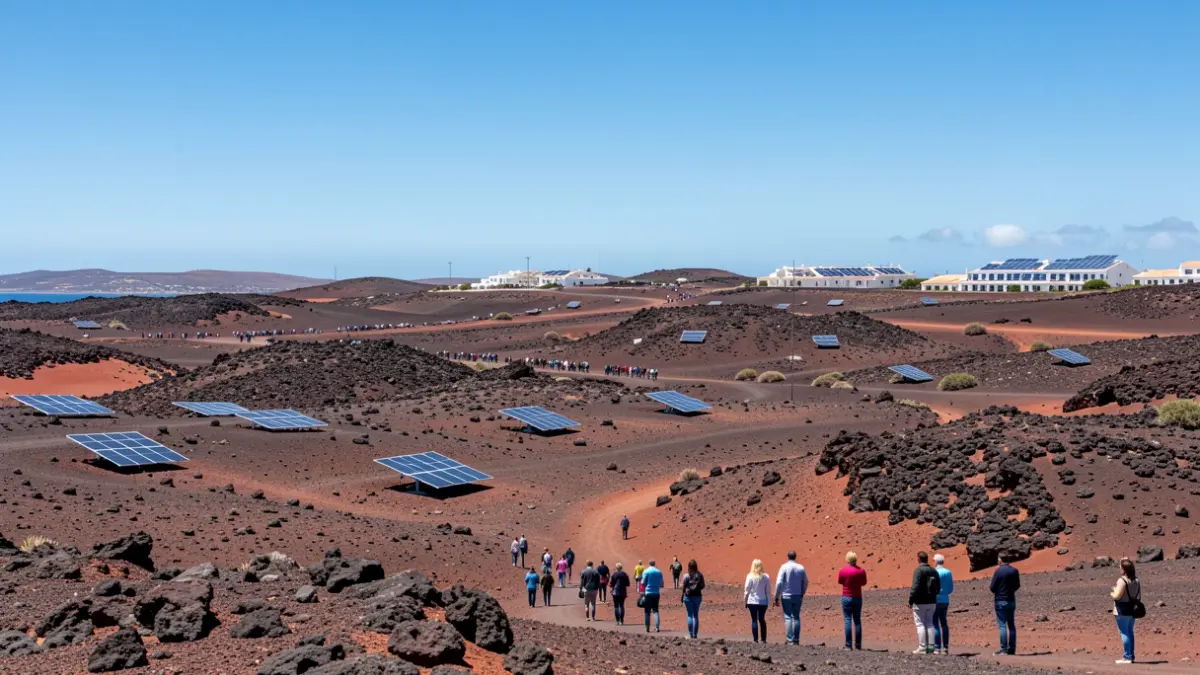
Following the controversy generated by a previous agreement that included reserving 3,163 hectares of virgin land, the insular corporation has sent a report to the seven municipalities proposing to limit occupation to 200 hectares (0.25% of the territory). The new strategy aims to implement renewables without damaging the landscape, a value that the document, prepared by architects Vicente Mirallave Izquierdo and Flora Pescador Monagas, considers "one of the highest values to preserve".
The report suggests a series of locations that will now need to be validated by the municipal governments, who have three weeks to submit their contributions. The ultimate goal is to achieve energy self-sufficiency by 2040, concentrating the implementation of renewables "primarily" in spaces already transformed or altered, such as rooftops of public and private buildings, and obsolete or degraded areas.
It highlights Lanzarote's capacity to move towards a more self-sufficient energy model without compromising its environmental and landscape values. Implementation must be compatible with quality of life, preserve traditional uses and economic, agricultural, and tourist activities. The study aligns with the César Manrique Foundation on the importance of social participation and advocates for public management and collective self-consumption.
Energy development should avoid the "indiscriminate dispersion of installations" and prioritize areas such as rooftops, which, according to a study by the Technological Institute of Canarias, have approximately 910 hectares suitable for photovoltaic energy, with the potential to generate 906 megawatts. The residential sector would account for 55% of this area, followed by hospitality (15%).
The report includes 70.94 hectares of degraded spaces, including quarries such as those of Lanzagrava, Hermanos Tavío, and Horinsa. Energy generation will be linked to consumption centers, such as urban areas or existing infrastructure. A photovoltaic park is planned near the Tahíche prison for the integral water cycle, mitigating the high energy consumption of desalination.
Energy consumption in 2024 was distributed among households (28.59%), accommodation (27.98%), and the water cycle (13.72%). The study also proposes leveraging the electrical connection between Lanzarote and Fuerteventura to create a "single space for shared renewable energies".