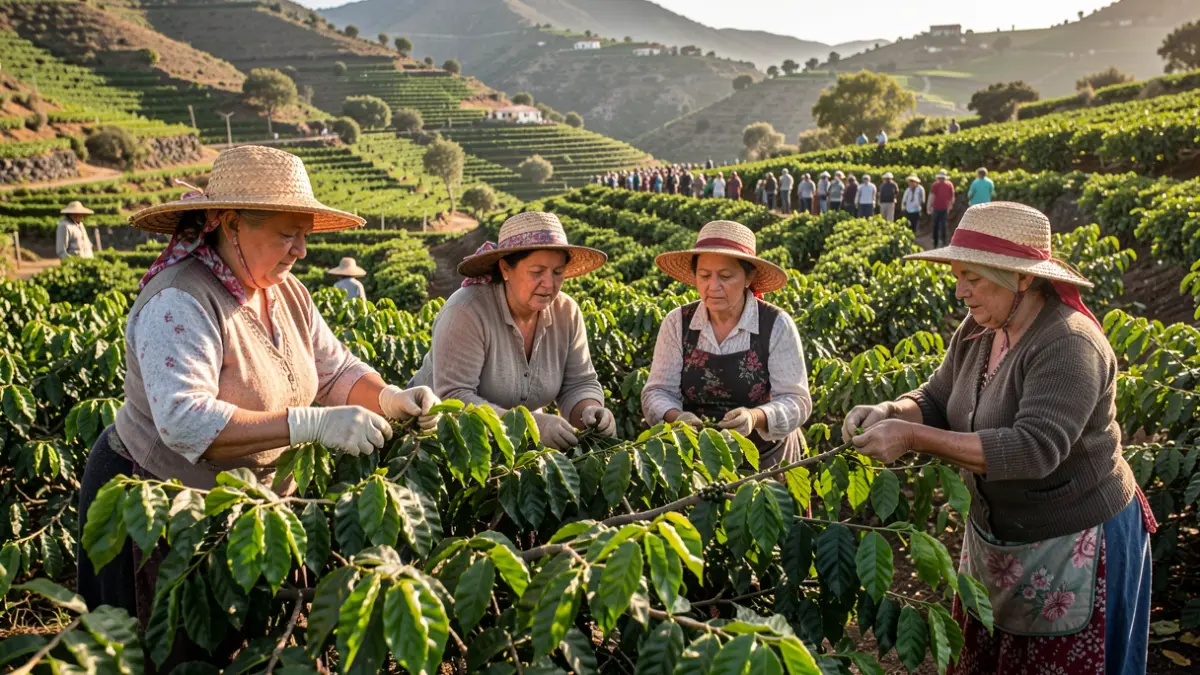
In the picturesque Agaete Valley, dozens of people had the opportunity to learn the best-kept secrets of coffee cultivation from four leading women in the field: Marusa Dámaso, Chona Sosa, Julia García, and Teresa Díaz. These experts shared the knowledge acquired over years of dedication to the harvesting and production of a coffee variety considered unique worldwide.
The initiative, promoted by the Agaete City Council and part of the 'Café de Mujer' (Women's Coffee) brand and the Umbrella Project supported by AIDER Gran Canaria, aims to educate the public about coffee production methods in the valley and the environmental conditions that give it its characteristic flavor. The harvesters emphasized that love, enthusiasm, sacrifice, and passion are key to obtaining one of the few naturally grown coffees in Europe.
Yesterday's event was the first of three planned sessions, bringing together 20 people at the Los Castaños farm to learn a local trade with over 200 years of history. The City Council's technical coordinator, Germán Suárez, described the attendance as a 'total success,' with 34 people registered for upcoming workshops.
The training began with a talk by José Manuel Sosa, a technician from the Cabildo's Agrarian Agency, on coffee bean formation and optimal harvesting techniques. Afterward, Marusa Dámaso, with nearly half a century of experience, detailed the importance of selecting beans at their exact maturity stage, noting that the harvesting season typically runs between March and July.
José Manuel highlighted that the spring months are a time of great satisfaction for the coffee farmers, as they see their year-long effort of 'nurturing' the plants rewarded. Marusa, on her Las Chozetas farm, along with her son Carlos Jiménez, conducts constant checks to collect ripe beans, producing coffee under the JD Las Chozetas brand.
The couple Julia García and Manolo Lugo, managing the La Morreta farm with over 1,400 plants, have been dedicated to coffee for more than 40 years, becoming professionalized in the last 20-25 years. They also cultivate oranges and guavas, considering affection and care for the plants their 'secret recipe'.
Teresa Díaz, an automotive specialist technician, views coffee cultivation on her Tevevi farm more as a hobby than a primary activity. She started 18 years ago, finding agriculture her 'gym and psychologist,' and still considers herself an apprentice.
These workshops not only introduce the coffee tradition to the public but also highlight the efforts of the women in the enclave. Chona Sosa, owner of the Los Grimones farm, exports coffee to Japan and learned the trade as a child. She emphasized the importance of safety during the activity and coffee's role in the identity of the Agaete Valley.
The post-harvest process includes washing and drying the beans, which requires daily movement to prevent moisture buildup. After a drying period of fifteen days to a month, the beans are hulled, selected, roasted, and finally ground.