The Ministry's contracting board has agreed to the provisional award to the UTE (Temporary Union of Companies) comprising Sacyr Construcción, S.A.; Cavosa Obras y Proyectos, S.A.; AMC Construcciones y Contratas 2014, S.L.; and Lopesan Asfaltos y Construcciones, S.A.U. This consortium has submitted a bid nearly twenty million euros lower than the 215 million euros initially estimated by the Government of the Canary Islands.
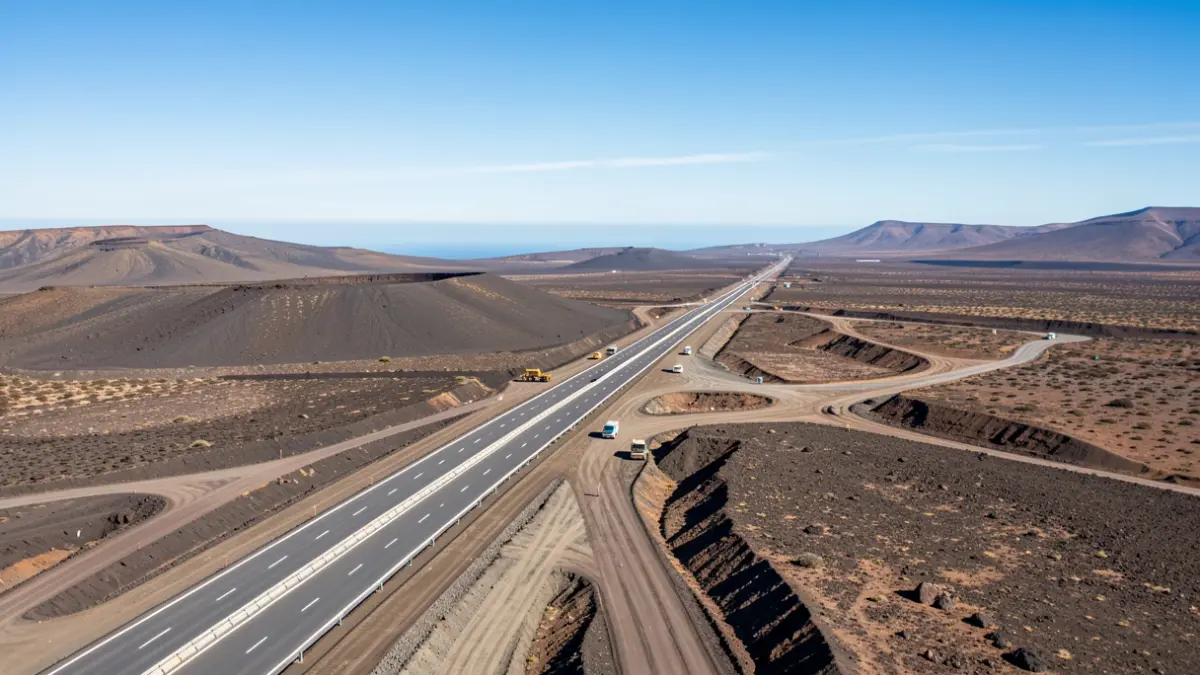
The project, to be executed over five years and expected to be completed no earlier than 2030, aims to improve connectivity between the north and south of the island, reduce travel times, and enhance road safety. It is part of the strategic infrastructures included in the Canary Islands-State Road Agreement.
Among the constructive solutions, the execution of Fuerteventura's first twin-tube tunnel, approximately 1.2 kilometers long, stands out. It is designed to minimize environmental impact and protect sensitive habitats and species like the Canarian bustard. The project also includes a 190-meter viaduct over the La Torre ravine and false tunnels.
The project encompasses the Aeropuerto-Cruce de Pozo Negro section of the Puerto del Rosario-Morro Jable road and includes new interchanges to improve connections with roads FV-2, FV-413, and FV-50. These connections will optimize access to the airport, Caleta de Fuste, and urban and rural centers in the municipality of Antigua.
The future highway will facilitate access to residential, tourist, and economic areas, and is expected to stimulate the island's economy through activity and job creation. The project incorporates energy sustainability measures, such as photovoltaic systems for lighting the tunnel and interchanges.