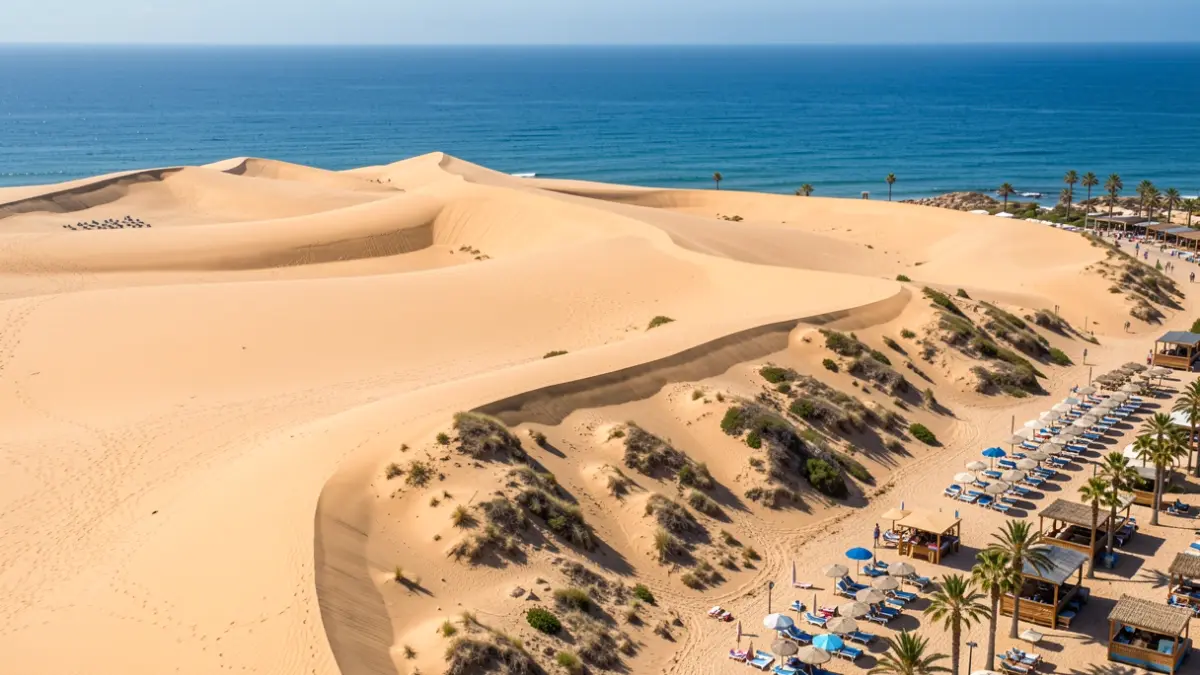
The Maspalomas dune system in San Bartolomé de Tirajana faces significant degradation, with sediment loss reaching 64% in areas most exposed to tourist activity, such as near sunbeds and kiosks. This alarming figure comes from a project by the Cabildo de Gran Canaria seeking authorization from the Demarcación de Costas de Canarias to extract excess sand accumulated along the Paseo Costa Canaria. The proposal aims to deposit this material on the shore of Playa del Inglés, reintegrating it into the natural wind dynamics.
The technical report supporting the request details that removing direct negative impacts, like the presence of sunbeds, could reduce the degraded area by 85%. These figures are the result of years of measurements and studies from the Masdunas project, an initiative by the Cabildo focused on conserving and restoring the valuable dune ecosystem. The environment's fragility has been compromised not only by surrounding tourist developments but also by less invasive uses, such as the operation of seasonal beach services.
Between 2018 and 2024, within the 34.18 hectares analyzed in the reserve (which spans 403 hectares), a displacement of 18,116 cubic meters of sand towards the interior of the dune field has been recorded. However, the actions of the Masdunas II project have prevented the displacement of at least 14,000 cubic meters of sand, strengthening the coastal dune, particularly in the Playa del Inglés area.
The technical report concludes that the Masdunas II project is significantly strengthening the most anthropized part of the coastal dune, preparing it for future sea-level rises associated with climate change. Aerial imagery shows a renaturalization of the area and an improvement in the conservation status of the balancón ('Traganum moquinii'), a priority species of community interest.
Other project figures include the planting of 1,064 balancón specimens, shrubs that help retain sand, and the installation or relocation of 5,919 bollards and stakes to delineate conservation areas. The Masdunas I project (since 2018) had already incorporated approximately 60,000 cubic meters of sand extracted from Punta de la Bajeta. The second phase has focused on reinforcing the coastal dune.
According to project calculations, an annual extraction of 14,413.20 cubic meters of excess sand accumulated along the Paseo Costa Canaria, between the Mirador de las Dunas and the Hotel Santa Mónica, would be necessary. These works, with an estimated budget of 201,919 euros and a minimum duration of 3.52 months, would be carried out in the morning. The San Bartolomé de Tirajana City Council has recently undertaken the movement of 7,072 tons of sand.