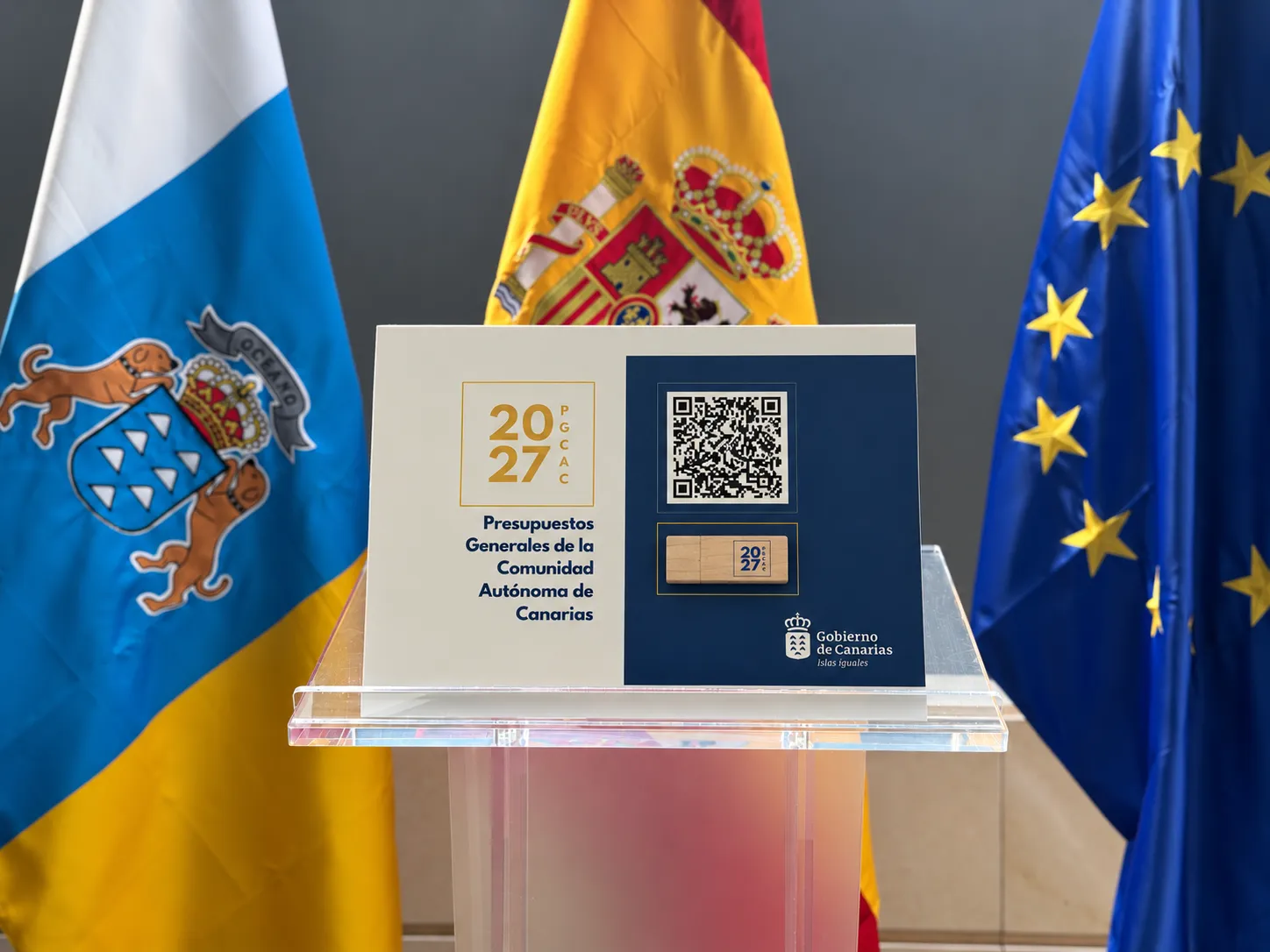
The Ministry of Finance and Relations with the European Union of the Government of the Canary Islands, headed by Matilde Asián, has met the legal deadline for submitting the draft General Budget Law for 2027 to the Parliament for the fourth consecutive year. The public accounts, amounting to a total of 13.209 million euros, will primarily focus on social policies.
The preparation of this budget has been marked by uncertainty stemming from the extension of the General State Budgets, leading to the disappearance of 20% of the initially allocated items. Furthermore, delays in updating the Autonomous Financing System (SFA) advance payments could result in a shortfall of 170 million euros per month. Macroeconomically, geopolitical instability and the fuel crisis add complexity.
The budget has been drafted cautiously given the significant uncertainty. As the Congress of Deputies did not approve budgetary stability objectives, a deficit target of -0.1% of GDP has been set. The reference rate for computable spending growth is set at 4% for 2027. The Canary Islands Government forecasts a GDP growth of 1.1% and an unemployment rate of 12.4%. The projected debt stands at 6,727 million euros (9.73% of GDP).
Two key factors for the 2027 budget are the disappearance of funds from the Recovery and Resilience Facility (MRR), representing a reduction of nearly 500 million euros in credits, and a 4.5% salary increase (with an additional 0.5% variable based on CPI) for public employees, amounting to another 500 million for the autonomous community and raising chapter I expenditure to 42% of the total budget.
Despite these circumstances, the areas of Health, Education, Social Action, Justice and Security, and access to Housing account for almost 83.3% of the budget (excluding MRR), reinforcing basic public services with an initial increase of 970 million euros. Health will receive an additional 429.8 million (9.1%), Education 260 million more (10.2%), Social Action 201.5 million more (24.4%), Justice and Security 41.9 million more (15.2%), and Housing 37.1 million more (22.8%).
Regarding investment by island, Tenerife will receive 261.7 million euros and Gran Canaria, 249.2 million. Fuerteventura will have 110.2 million, La Palma 102.6 million, Lanzarote 90.1 million, La Gomera 74.6 million, El Hierro 44.6 million, and La Graciosa 1.9 million.
Revenues are primarily supported by increased resources from the Autonomous Financing System (SFA), own taxes, and the REF block. Current transfers also rise due to the inclusion of state funds from the Dependency Law and the subsidy for free public transport.
In fiscal matters, the Government will adjust the regional personal income tax (IRPF) tariff to the CPI to protect citizens' disposable income. The zero rate for the Canary Islands General Indirect Tax (IGIC) will be extended to accommodation and food services provided by student residences. The exceptional taxation of fuel imports and deliveries will be extended, as will the temporary subsidy on fuel prices until January 2027. Tax limits and rates for tobacco products will be adjusted to align with mainland Spain and the EU.