The Canary Archipelago, Spain's only region with active volcanic risk, is at the center of a discussion regarding the management of its volcanic surveillance. Currently, this task has been carried out by the National Geographic Institute (IGN), under the Ministry of Transport, since 2004. However, the Government of the Canary Islands is requesting the Ministry of Science to have the future National Vulcanology Center (CNV) assume "comprehensive management of the volcanic phenomenon," which could encroach upon the IGN's responsibilities.
The controversy intensified after the Cabildo of La Palma's complaint about the state's "blockade" of the CNV. Many believe that, given the islands' unique volcanic activity, management should be local. The Geophysical Center of the Canary Islands, a branch of the IGN in Santa Cruz de Tenerife, has been operational since at least 1958, conducting seismic detection and directing national volcanic emergency management.
The IGN's presence in the islands dates back to 1911, with reports following the Chinyero eruption. In 1952, the first official seismometer, the Victoria, was installed, and the Geophysical Observatory of Santa Cruz de Tenerife was created. Volcanological interpretation began to take shape in 1974, and in 1981, a project to study the seismology of Teide was initiated.
Uncertainty regarding responsibility for volcanic surveillance became evident in 2004, during the activity of Teide. Faced with a competence gap, Royal Decree 1476/2004 assigned the IGN the responsibility for "observation, surveillance, and communication of volcanic activity" and the determination of associated risks.
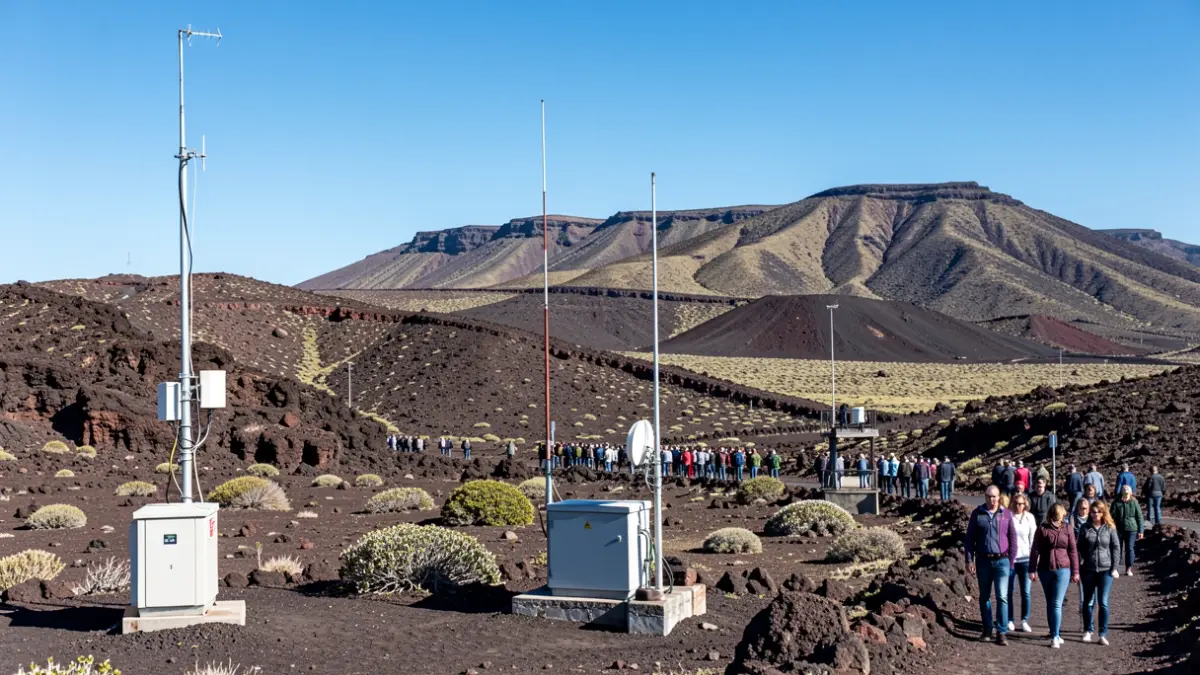
Since then, the IGN has expanded its surveillance network in the Canary Islands, installing over 100 stations to monitor seismology, ground deformation, and gas emissions. In Tenerife, there are 26 seismic stations, 19 GNSS antennas, 4 visual and thermal cameras, 4 geochemical continuous measurement stations, and 7 inclinometers. La Palma and El Hierro, islands with the most recent eruptions, also have an extensive monitoring network.
Despite the state service being oriented towards the Canary Islands, the decision to centralize management sparked rejection in the Archipelago, which aimed to consolidate the Volcanological Institute of the Canary Islands (Involcan), established in 2010. The transfer of competencies thwarted previous plans to create a Canarian volcanological center, despite unanimous requests in the Senate, the Parliament of the Canary Islands, and the Congress of Deputies.
The Minister of Science, Diana Morant, views the creation of the CNV as a way to unify organizations and research groups working on volcanology in the Canary Islands, establishing an international reference center. The current discussion focuses on whether this center should integrate the IGN, not only in research but also in its competencies.