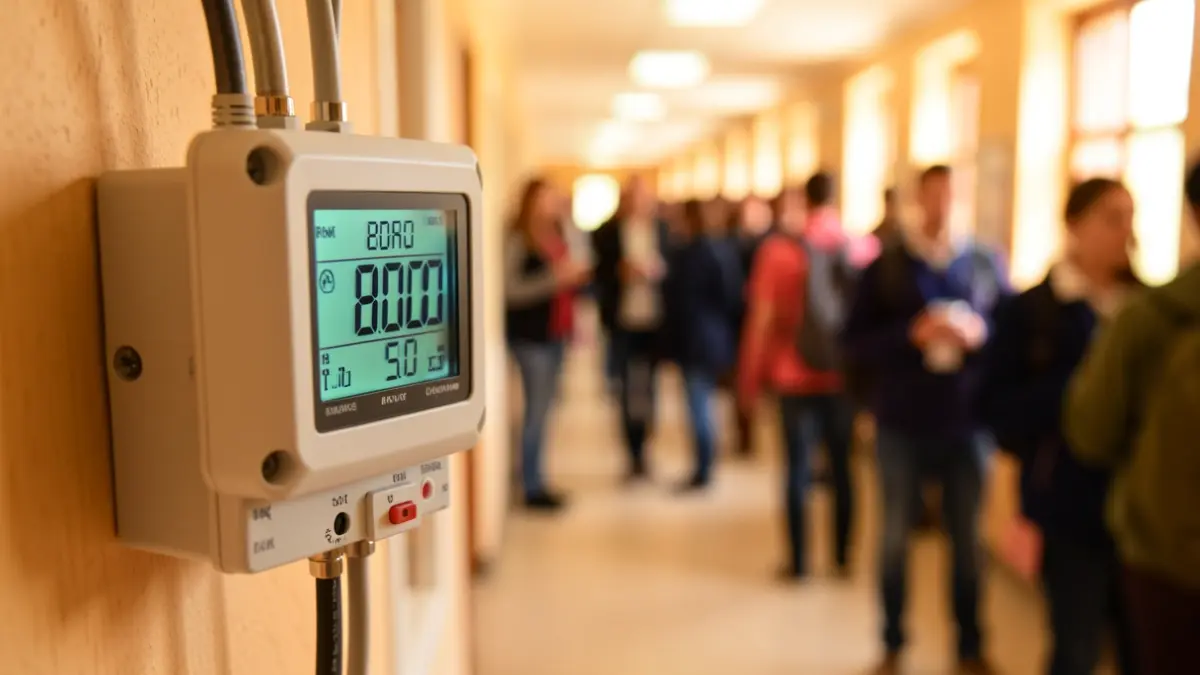
The Canary Islands Ministry of Education has launched a pioneering initiative in Spain, named 'Clima Escolar Canarias' (Canary Islands School Climate), to tackle heatwaves in educational institutions. The pilot project has involved the installation of 240 temperature sensors in 120 schools and institutes spread across all islands and municipalities of the archipelago.
This measure aims to provide a precise overview of how educational facilities perform during extreme heat episodes, with the goal of facilitating decision-making and ensuring more comfortable spaces for students and staff. Real-time data on temperature, humidity, and air quality will be centralized on a digital monitoring, analysis, and management platform.
The Vice-Minister of Education, José Manuel Cabrera, accompanied by the Director General of Educational Infrastructure and Equipment, Iván González Carro, and Gesplan architect Silvia Guajardo, presented the initiative. Cabrera emphasized the importance of understanding the facilities' condition to improve them and implement appropriate measures, highlighting that the project aims for the "well-being" of the educational community.
The digital platform will not only record climatic data but also include information on buildings, surroundings, vegetation, and shaded areas of each center. This will enable the provision of personalized solutions, ranging from the installation of cooling and air conditioning systems to enhancing vegetation and shade, addressing both heat and cold.
Silvia Guajardo described the tool as "dynamic," capable of displaying real-time temperature, data from the last day, or historical records, allowing for the analysis of sun exposure hours to plan shade installations or space naturalization. The tool also offers a technical proposals tab with solutions of varying scales, from small actions to major works.
Iván González Carro announced plans to expand sensor installation to more centers, although the current sample is already representative of the archipelago. He noted that this action completes the Plan for Adaptation to High Temperatures, which has already implemented other measures such as updating the protocol for heatwaves, providing shaded areas in 326 centers, roofing sports courts in over twenty schools, space naturalization, and the installation of photovoltaic energy.
Vice-Minister Cabrera concluded by acknowledging that transforming over a thousand educational centers is a long-term process, but stressed that detailed knowledge of the circumstances is key to making the best decisions and "improving the well-being of students and staff."