The main value of the eCall system is to reduce the time between an accident, its detection, and the activation of emergency resources. Demands received by the European device have increased by 168% since 2023, surpassing 500 connections in 2025, an increase reflecting the Emergency Coordination Center's adaptation to the universal accessibility regulatory framework.
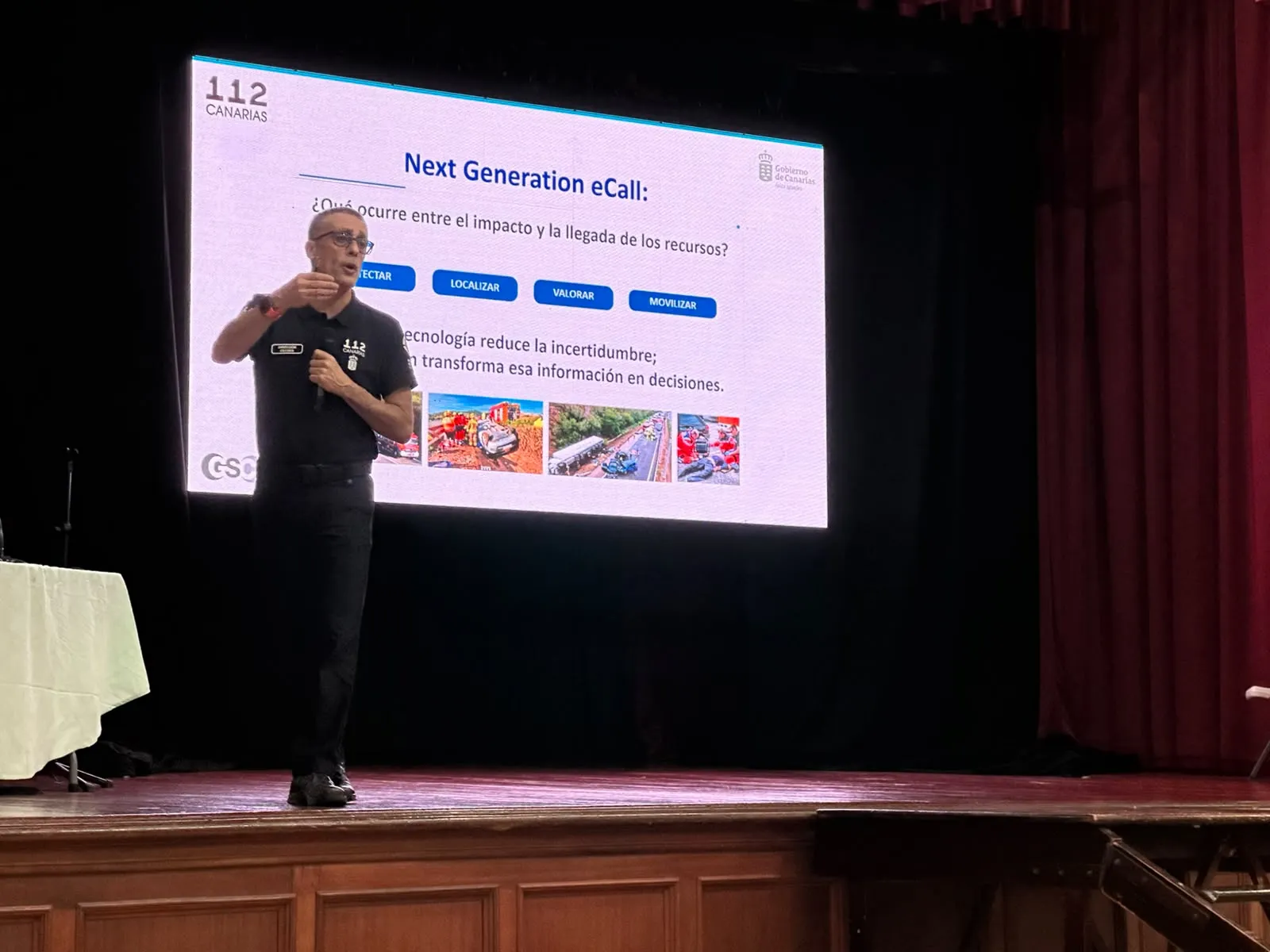
The Emergency and Security Coordination Center (CECOES) 112 Canarias, under the Canary Islands Government's Ministry of Territorial Policy, Territorial Cohesion and Water, more than tripled the number of automatic calls to the single number via the eCall alert system over the last three years. CECOES director Moisés Sánchez detailed the system's technological evolution and the increase in demands for this safety tool, which directly connects vehicles to 112, during the II Meeting on Traffic Accident Intervention of the Tenerife Firefighters Consortium, held in La Orotava on November 16 and 17.
Specifically, automatic calls from eCall to the 112 number increased in the Canary Islands by 168.3% between 2023 and 2025, from 199 contacts in the first year to 534 connections in the last fiscal year. This increase highlights the importance for CECOES 112 Canarias to continue adapting its technological and operational capabilities to ensure an effective response to these types of emergency communications.
Law 11/2023 incorporated the accessibility requirements of Directive (EU) 2019/882 into Spanish law, including those applicable to emergency communications to the single European number 112. Furthermore, Royal Decree 193/2023 contributes to ensuring more accessible and inclusive emergency care, alongside the technological evolution of the eCall system towards its new generation (NG eCall), which replaces 2G and 3G networks with 4G and 5G technologies, improving reliability and information transmission.
The eCall system, an EU initiative, provides rapid assistance in traffic accidents. Factory-installed (mandatory in new vehicles since 2018), it makes an automatic or manual call to 112 in case of a major impact, providing data such as geographic location, direction of travel, time of incident, vehicle identification number, vehicle type, propulsion type, and number of occupants. While it doesn't replace the emergency manager's assessment, it offers crucial data for locating the incident and speeding up emergency response.