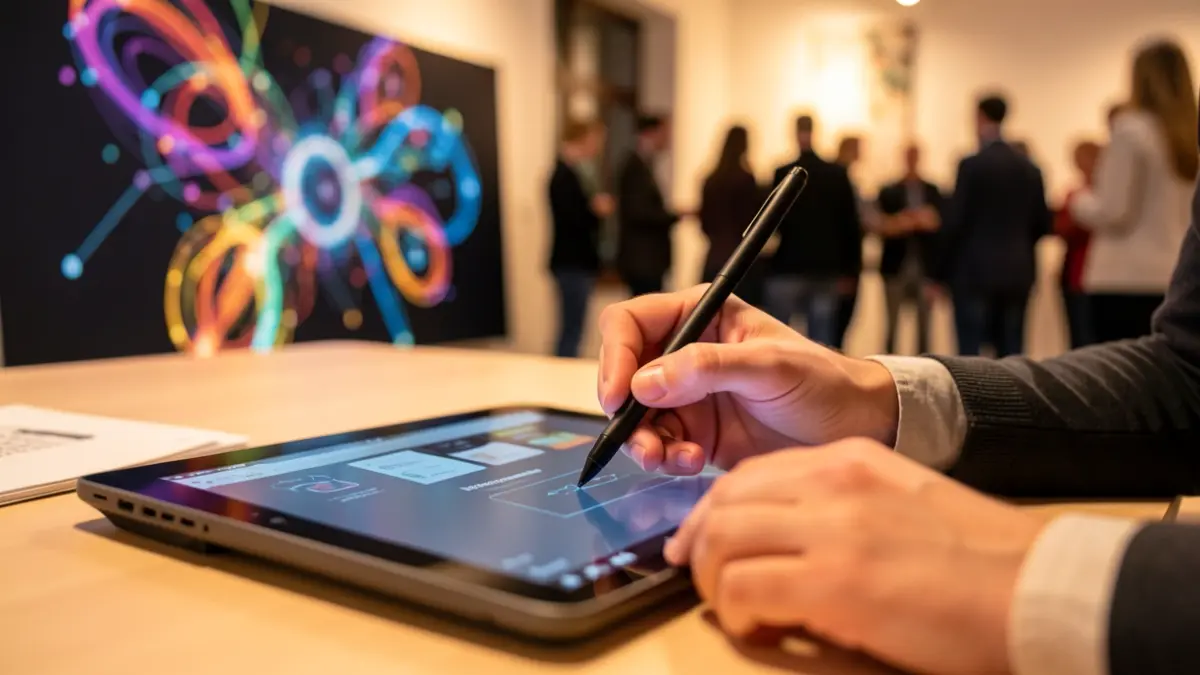
Jorge Leal, a renowned graphic designer with a quarter-century of experience in the Canary Islands, has recently integrated artificial intelligence (AI) into his workflow. Leal emphasizes the importance of using these tools consciously and strategically, describing them as a "crutch" that supports, but does not replace, the human creative foundation.
The designer warns about the aesthetic homogenization that can arise from the indiscriminate use of predefined prompts in AI. "In the long run, that will create a very continuous aesthetic where everything looks the same, and it will become tiresome," he notes. To counteract this, Leal dedicates time to customizing AI outputs in programs like Photoshop, adding a human and unique touch to his creations, especially in logos, typography, or posters.
AI has streamlined the sketching and initial proposal process for commissions such as album covers or posters, saving considerable time. However, Leal observes a shift in client dynamics. "Before, they depended on your creativity. Now, they also work with AI, giving you a brief of what they are looking for with an AI-generated aesthetic," he explains. This can complicate the proposal phase, as clients often arrive with pre-formed ideas, expecting immediate results.
Despite the conveniences it offers, Leal dismisses AI as a direct threat to the profession. "It's like saying you're going to be a farmer because you have a tractor," he compares. He stresses that continuous training and "common sense" are essential for using it effectively. Companies, in his experience, are also reluctant to rely solely on AI, preferring "personal" commissions that reflect the authorship and originality of a human creator to avoid repetition.
Leal has been applying AI "powerfully" for about a year and a half, starting out of curiosity with video montages and clips related to the Canary Islands. What began as a hobby, with a critical tone or an exaltation of the island, gained popularity and led to professional commissions. His work ranges from images for events and political campaigns to photographic updates and designs for film festivals, the Carnival of Las Palmas de Gran Canaria, auditoriums, and companies.
Regarding tools, he mentions that many design and video editing programs now incorporate AI, simplifying tasks that previously required hours. "With one keystroke, we solve three hours of work," he states. The main challenge lies in "educating" the AI, that is, learning to communicate with it effectively to achieve the desired results.
The designer concludes that, although AI will continue to advance and professionalize, the "most beautiful or visual part" of design will regain its value. "It's a wave of trends that will always be there; we will need it and adapt, but we will all keep moving forward," he assures, anticipating future saturation and the need for constant adaptation in the sector.