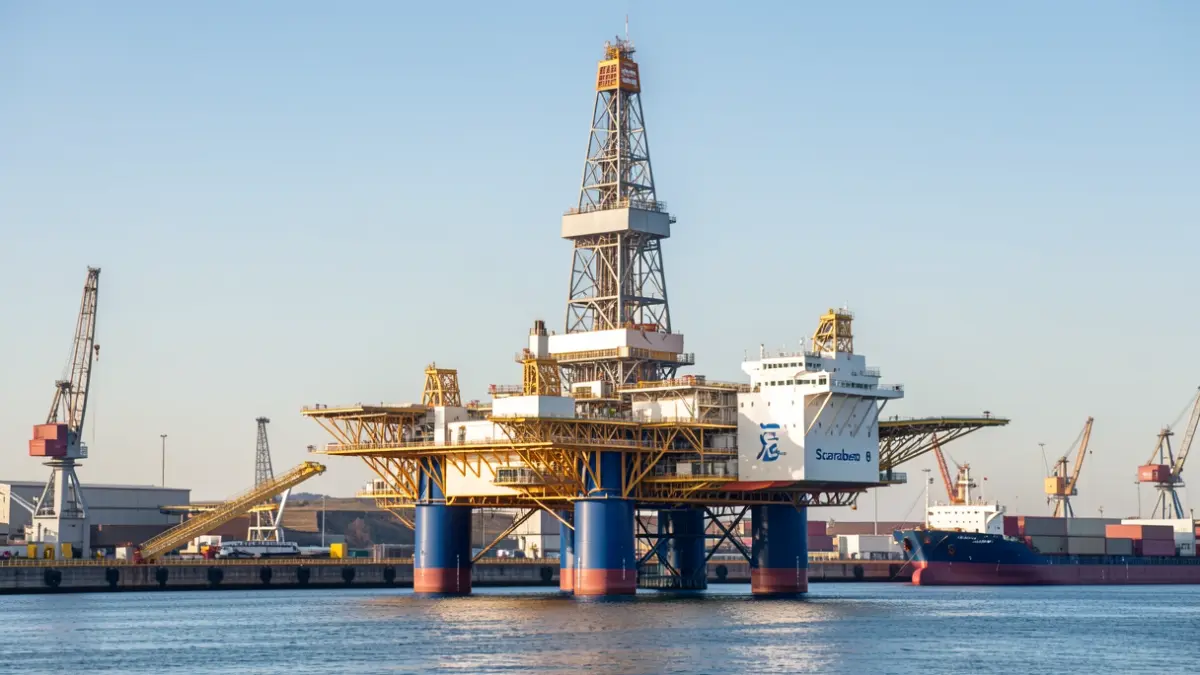
The oil platform Scarabeo 9, which at one point exploited a legal loophole to evade sanctions imposed on Russia in 2014, has once again docked at the Port of Las Palmas. The vessel arrived from Palermo, Italy, and after a brief stay in the North Roadstead, berthed at the Reina Sofía Pier on Tuesday.
This vessel, a sixth-generation, ultra-deepwater semi-submersible drilling platform owned by Saipem, was built in China in 2011. It is designed to operate in water depths of up to 3,650 meters and can drill down to 15,000 meters. With a length of 115 meters and a beam of 78 meters, it features advanced dynamic positioning systems to ensure its stability.
The Scarabeo 9 was involved in one of the most unique naval engineering operations at the Port of Las Palmas in October 2016. It initially arrived for a mandatory inspection, but a work opportunity arose in the Black Sea that required an unprecedented logistical intervention.
To access the Black Sea, the platform had to cross the Bosphorus strait, but the bridges over this waterway limited the height to approximately 64 meters, less than the platform's drilling tower. The solution, executed by Astican, involved a detachable system to remove and re-install the approximately 200-ton steel drilling tower, allowing passage without new welding.
Furthermore, the platform was adapted for operating in cold climates, with the installation of panels and protections against the low temperatures, wind, and humidity characteristic of the Russian region. Subsequently, about 60 workers from Astican traveled to Romania to reassemble the tower.
The Scarabeo 9's operation in Russia, despite the sanctions regime, was highlighted by international media. The company relied on legal and technological factors: sanctions primarily targeted US-origin technology, while the platform used Norwegian technology and was built in China. Additionally, the contract was signed in 2013, before the sanctions came into effect, allowing it to benefit from certain exceptions.