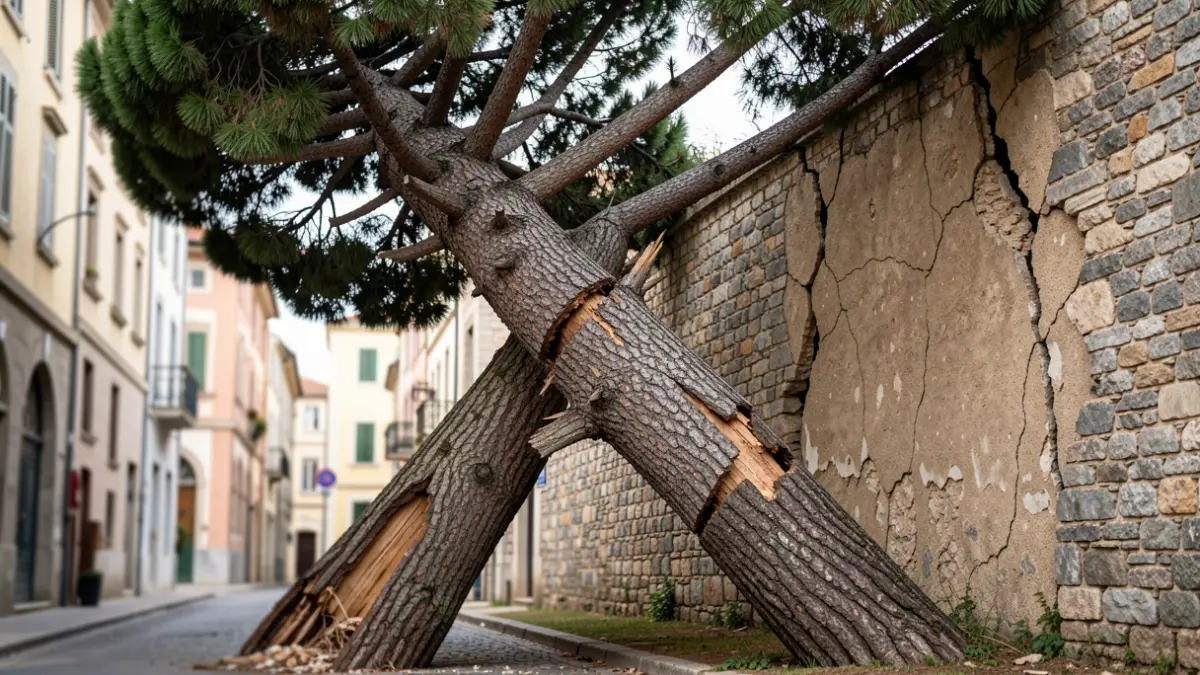
The Santa Brígida City Council, through its Parks and Gardens Department, has completed an emergency intervention to fell a Canary Island pine tree (Pinus canariensis) located at the intersection of Castaño Alto street and Calvo Sotelo street, near the GC-15 road. The decision was made due to the severe threat of falling, which endangered the physical integrity of pedestrians, drivers, and adjacent homes.
The immediate removal of the tree was decided after expert analyses and field inspections by the technical services and the specialized company Acciona Medio Ambiente. This measure also responded to complaints and warnings from local residents regarding the tree's condition and the potential risk it posed.
The operation proceeded without operational incidents or material damage. The felling addresses a situation of extreme fall risk, deemed necessary and urgent to preserve safety at this location.
The technical assessment determined that the specimen, approximately 15 meters high and 0.50 meters in trunk diameter, had a Failure Potential classified as 'Very High' (Level 3). Combined with a 'Constant' Occupancy Target (Level 5), the final Accident Risk was of extreme gravity.
The detailed inspection revealed a pronounced and irreversible lean of the trunk towards the public road and adjacent urban properties. The tree exerted significant weight and mechanical pressure on a masonry perimeter wall, which already showed considerable cracks and deterioration. Experts highlighted that the wall's structure acted as an unstable temporary lateral stop, and its failure could have caused the sudden collapse of the pine. The large crown also acted as a sail, increasing leverage during strong winds.
Given the plot's spatial characteristics, the City Council technically ruled out any alternative conservation or stabilization methods. The tree's location in a small plot limited root development, making transplanting impossible due to the species' size and the limited space for root extraction. Furthermore, thinning pruning or installing support systems were insufficient to correct the severe lean and the wall's deterioration. As it was not feasible to sufficiently reduce pedestrian and vehicle exposure due to regular traffic, controlled felling was determined as the only technically viable option to ensure safety.
Although the Canary Island pine is a protected species, regulations and institutional responsibility mandate necessary measures when a specimen poses a safety risk. Therefore, immediate felling was deemed necessary to eliminate the potential risk before adverse weather or the eventual deterioration or collapse of the supporting wall.
Following the complete felling, chopping, and removal of the tree, municipal operational services have restored pedestrian and vehicular traffic in the area. In the coming days, they will conduct a final assessment of the perimeter wall's structural integrity and plan landscaping interventions for the cleared space.