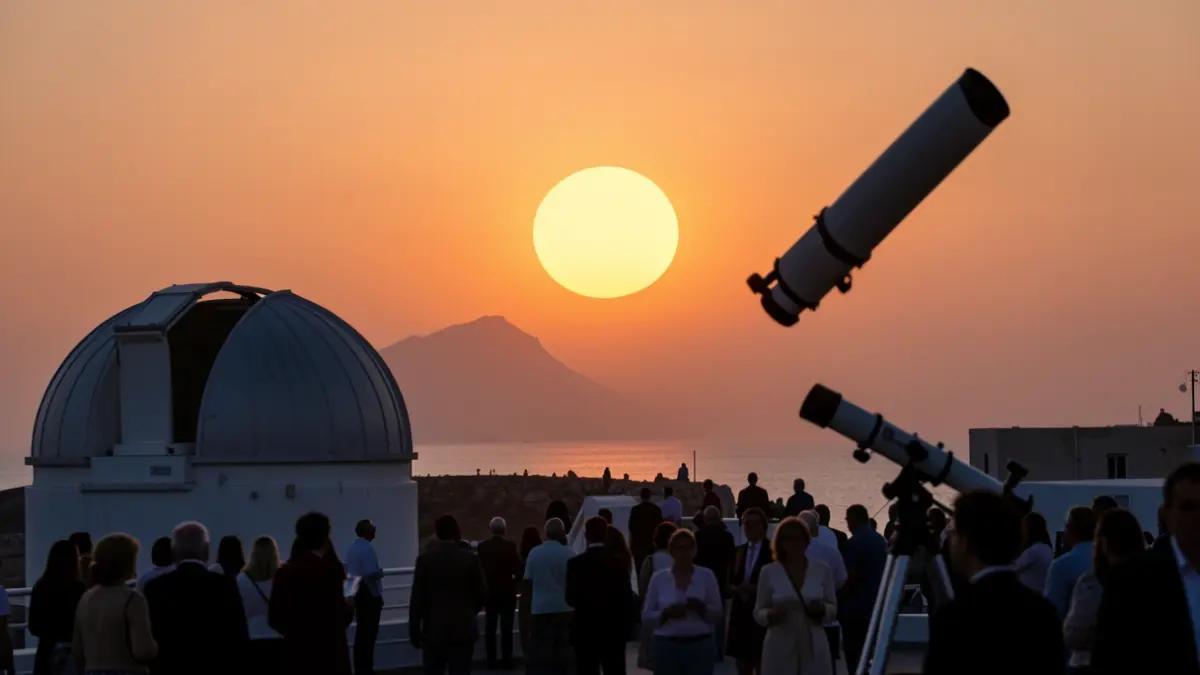
The Elder Museum of Science and Technology was the hub for the safe observation of the partial solar eclipse visible in the Canary archipelago. Its director, José Gilberto Moreno, highlighted the "commitment to open knowledge, prevention, and accessible scientific outreach throughout the Canary territory, through eight cosmic watchtowers across the Archipelago."
In total, over 20,000 people attended the various locations set up in the Canary Islands. Tenerife saw particularly high attendance, with the observation point at Playa San Juan exceeding 6,000 visitors. In Gran Canaria, the event in Tejeda attracted 3,500 people, while other islands averaged two thousand attendees. In La Graciosa, Caleta de Sebo gathered nearly a thousand people.
Thanks to the technical and human resources of the Elder Museum, with around 20 scientific communicators across the eight islands, the phases of the phenomenon were explained, and correct observation guidelines were provided. The museum estimates that one-third of the Canarian population viewed the partial eclipse from their surroundings and distributed nearly 40,000 certified glasses to ensure eye protection.
José Gilberto Moreno, director of the Elder Museum, expressed his satisfaction with the results and congratulated the staff and the public: "Our team has ensured that this solar phenomenon was enjoyed safely and responsibly. We want to highlight and thank the impeccable behavior of the citizens, which made this astronomical event an example of coexistence and passion for science."
The "Cosmic Watchtowers", strategically located for optimal visibility towards the west during sunset, served as the main meeting points: Tenerife in Guía de Isora (over 6,000 attendees); Gran Canaria in Tejeda; Lanzarote in La Santa (Tinajo); Fuerteventura at El Tostón Castle (El Cotillo); La Palma at Los Tarajales Beach (Tazacorte); La Gomera at Plaza de San Pedro (Valle Gran Rey); El Hierro in Los Sargos (La Frontera); and La Graciosa at the Port Plaza of Caleta de Sebo.
The organization involved local City Councils, the ONCE Delegation in the Canary Islands, and the Spanish Government Delegation, with the collaboration of the Guardia Civil and protection and emergency services. No incidents were reported.