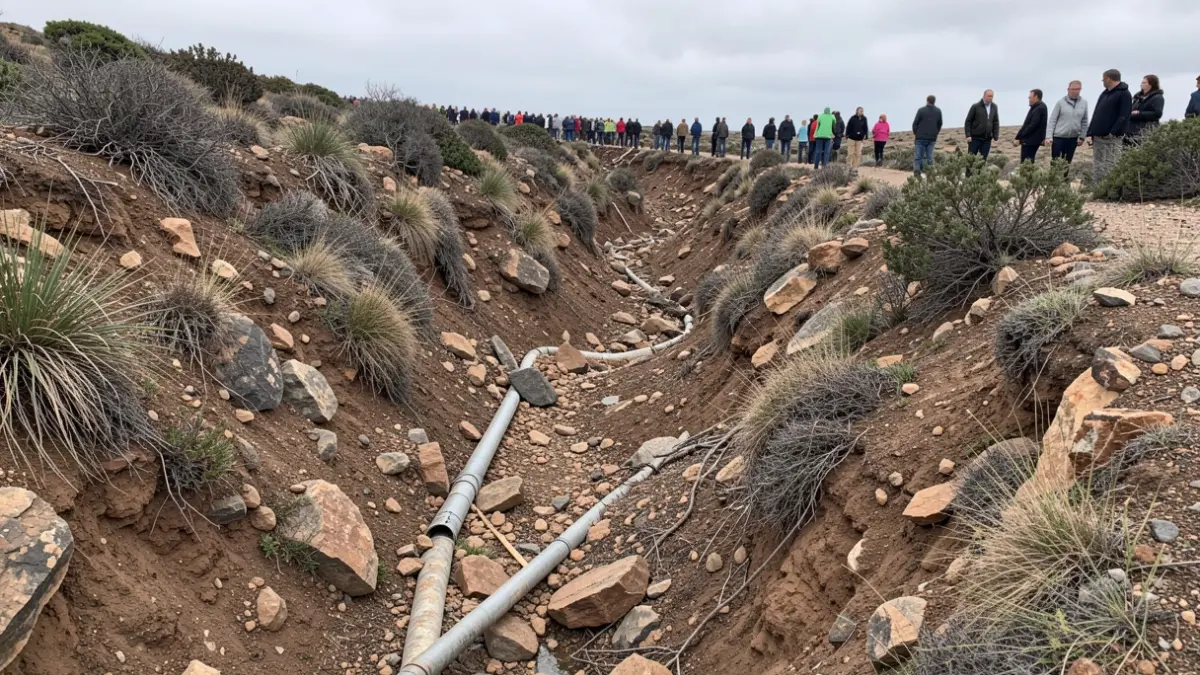
The Telde City Council hosted a coordination meeting at the Casas Consistoriales to advance the recovery of the Barranco de los Cernícalos, damaged by landslides caused by storm ‘Therese’ last March. The meeting, jointly promoted by the City Council and the Gran Canaria Cabildo, served to evaluate the actions taken so far and define new measures focused on the recovery of the natural environment, visitor safety, and ensuring the water supply for farmers and irrigators.
Participants included the mayor of Telde, Juan Antonio Peña; the councilor for the Cumbre District, Juan Martel; the Minister of Environment of the Gran Canaria Cabildo, Raúl García Brink; the Minister of Primary Sector, Food Sovereignty, and Water Security, Miguel Hidalgo; the manager of the Insular Water Council of Gran Canaria, Carmelo Santana; the insular director of Water Security, José Juan Pérez Suárez, and the president of the Heredad de Aguas del Valle de los Nueve, Juan Manuel Rodríguez López.
One of the key points was the removal of provisional pipes installed to maintain irrigation water supply to the community members affected by the channel alterations. It was reported that these works could conclude this Monday, October 26, coinciding with recent rains that have improved water circulation and partially restored flow in some sections. This removal is part of the follow-up on measures to meet the needs of irrigators, aiming for the natural recovery of the ravine and long-term solutions.
For its part, the Cabildo's Minister of Environment, Raúl García Brink, detailed the planned actions to improve information and safety for visitors. These include enhancing existing signage and installing information panels warning of dangers associated with the ravine's current state and access limitations in certain sections. Furthermore, improvements to paths up to the limits of public land are planned for 2027, respecting private adjacent properties.
Minister Miguel Hidalgo outlined the measures being developed since the start of the emergency in coordination with the Heredad de Aguas del Valle de los Nueve, as well as short and long-term strategies. The ravine's situation requires balancing environmental and hydrological recovery with the continuity of agricultural irrigation supply, as the landslides altered the usual watercourse, affecting numerous community members.
The Telde City Council has called for the involvement of competent administrations to ensure a coordinated response with defined responsibilities. The meeting concluded with a commitment to convene a new session involving citizen groups such as the platform Salvar el Barranco de los Cernícalos, the environmental group Turcón-Ecologistas en Acción, and the Neighborhood Association Ruta del Castillo, Arenales y La Colomba, to incorporate their proposals.
Mayor Juan Antonio Peña emphasized the importance of continuous dialogue and coordination between administrations and those directly affected. "The Barranco de los Cernícalos needs responses, coordination, and concrete actions. From Telde, we will continue working so that all involved administrations move forward together, with solutions that address both farmers and irrigators and the protection of our natural heritage," he stated.
Juan Antonio Peña added that "collaboration between institutions and the participation of citizen groups are fundamental for responsible progress. We want decisions to translate into real measures, with clear information, safety for ravine visitors, and a roadmap for continued recovery steps."
Councilor Juan Martel highlighted the work with the Heredad de Aguas del Valle de los Nueve and contact with residents and farmers. "We know firsthand the concern in our neighborhoods about the ravine's situation and its impact on irrigation water. It is important that actions continue, that supply to community members is guaranteed, and that we advance in the recovery of the channel and the safety of the trails," he stated.
Martel further stressed that "the solution requires listening to those who know the territory, the irrigators, the residents, and the groups that have defended this space for years. The objective must be to work jointly, respecting each administration's responsibilities and establishing commitments for a lasting solution."