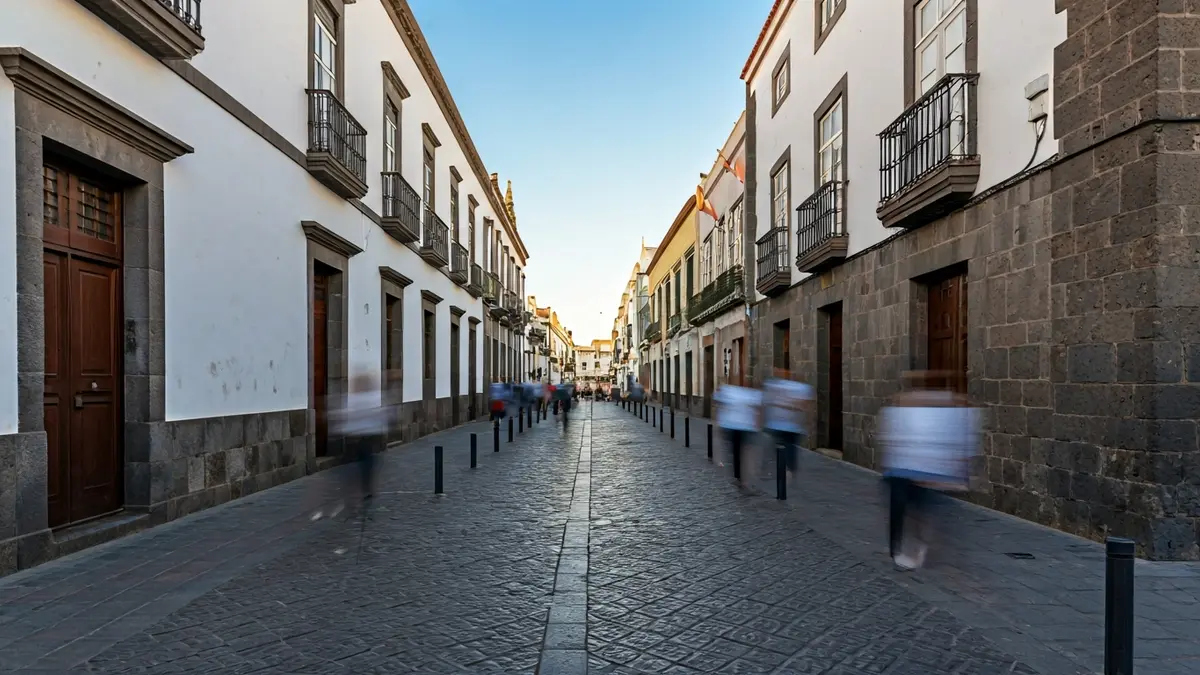
Although popularly known as Calle Castillo, its correct name is Calle del Castillo, a name that evokes its original connection to the fortress of the parade ground of the Castillo de San Cristóbal. This street, which today welcomes thousands of people daily, did not always have its current appearance, being the result of an expansion process that spanned three centuries.
Initially, the street extended from Plaza de La Candelaria (formerly Plaza del Castillo de San Cristóbal) to the current Calle Valentín Sanz in the mid-18th century. A century later, its layout reached Teobaldo Power. However, the biggest challenge was connecting this road with the upper part of the city, an objective that was not achieved until the late 19th century.
The final stretch towards Plaza Weyler (then Plaza del Hospital Militar) required the City Council to expropriate land and houses in 1873. Due to a lack of municipal funds, the solution came from the private sector: capital merchants advanced 21,500 pesetas with 6% interest through the Consumption tax. This financing was supplemented by the auction of demolition materials and the sale of surplus plots. Finally, on July 25, 1875, the city celebrated the union of Calle del Castillo with Plaza de Weyler, an event marked by the installation of an iconic “lantern tree”.
This new section quickly became a showcase for the economic boom of the era. In 1874, the Sociedad Constructora de Edificios Urbanos erected three emblematic buildings, including the famous “Casa del Barco” at the corner with Robayna, which later housed the Hotel Olsen’s Alexandra and the headquarters of the Olsen shipping company. British influence also manifested itself in 1903 with the building of the firm Elder Dempster y Cía., designed by architect Antonio Pintor, notable for its modernist doors carved by the Ruiz brothers.
Throughout its history, Calle del Castillo has had several names. After King Alfonso XIII's visit to the Archipelago in 1906, the street was renamed Alfonso XIII, a name it kept until 1932. Subsequently, it was known as Capitán Fermín Galán. However, from October 5, 1936, the street regained its original and most deeply rooted name: Calle del Castillo.