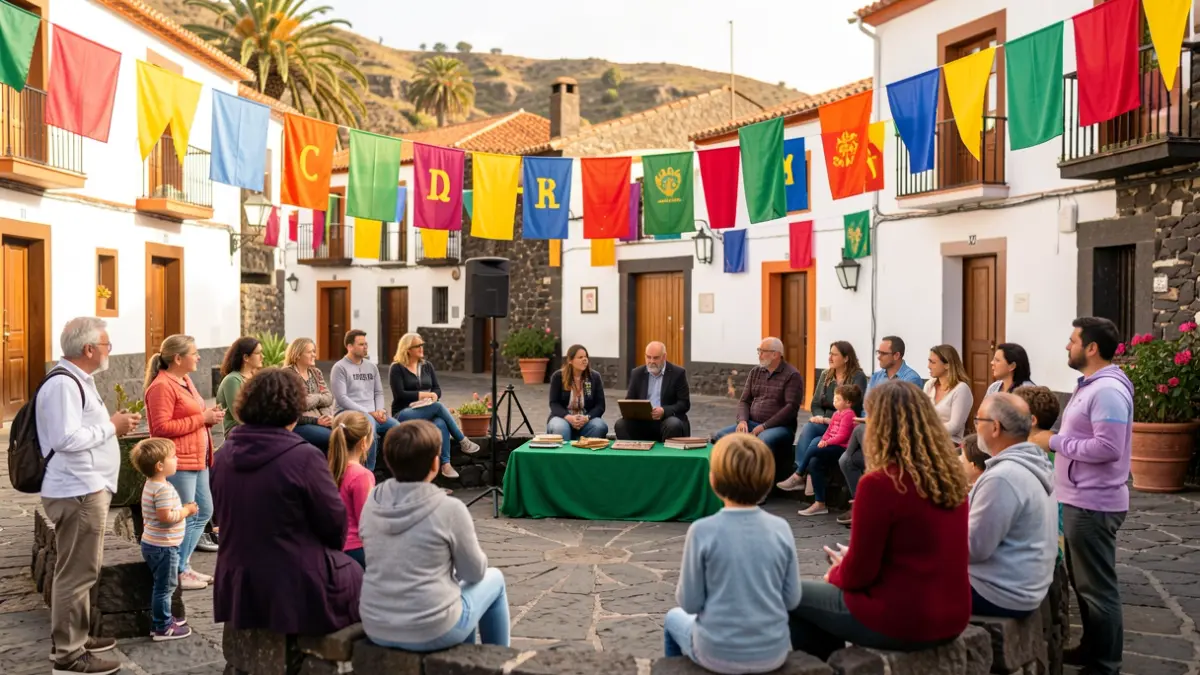
The event, held last Friday, was attended by institutional representatives, including the Vice-counselor of Administrations and Transparency of the Government of Canarias, and the Counselor of Culture of the Gomera Cabildo. The evening was marked by an emotional tone and recognition of the importance of family memory in shaping island history.
The opening of the event included an audiovisual work by Pedro Cruz Vera, which incorporated a piece with Gomera whistle language, creating an atmosphere deeply connected to the island's identity. Subsequently, Pablo Jerez Sabater, author of the prologue, highlighted the relevance of this type of research for Gomera microhistory and the rigor of the study.
Genealogist Guacimara Ramos Pérez addressed the scientific dimension of the book, explaining the complex research process due to the difficulty of accessing and reading old documents, as well as the loss of records in archives such as Chipude. Despite these challenges, the study managed to reconstruct the family lineage back to the year 1709.
The author, José Ramón Medina Marichal, detailed the contents of his work, focusing on the historical dissemination of the Medina surname from its origins to its establishment in La Gomera, and on the reconstruction of his father's family history, to whom he dedicates this book, the second of his career.
“"This book is not just a genealogy; it is a way of understanding who we are and where we come from. It has been a long but also very necessary work to give meaning to our own history."
The author added that his intention was to pay tribute to his father and, at the same time, to the many Gomera families with similar trajectories, highlighting the widespread presence of the Medina surname on the island and the common stories it represents. The presentation concluded in a close and emotional atmosphere, demonstrating the interest of Gomera society in historical research and the living memory of the island.