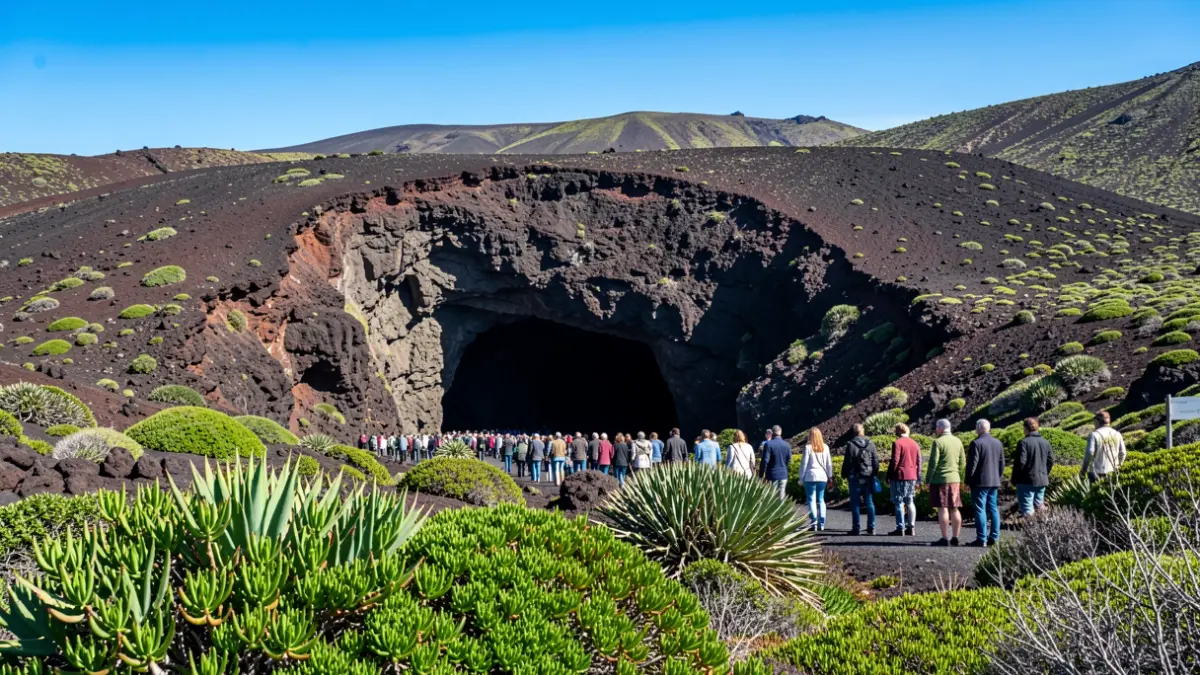
The Barranco de Agua de Dios, in Tegueste, hosts a significant group of natural caves used during the aboriginal period as burial and dwelling spaces. Cueva de Los Cabezazos has been the center of the fifth archaeological excavation campaign, funded by the Government of the Canary Islands in collaboration with the Tegueste City Council. The scientific team from the University of La Laguna (ULL) has extended the research to other cavities in the ravine to determine if this cave structured the Guanche settlement in the area.
Current dating places the aboriginal occupation of the Barranco de Agua de Dios between the 6th and 15th centuries AD. The systematic comparison of archaeological material from different cavities will allow for precise determination of when the ravine's use by the Guanche society began, consolidated, and ended, obtaining complete chronological sequences from an interdisciplinary perspective.
The team is re-examining materials recovered in the 20th century by archaeologist Luis Diego Cuscoy, currently preserved at the Museum of Nature and Archaeology (MUNA), in addition to intervening in new areas. The combination of this data will help determine if Cueva de Los Cabezazos was indeed the backbone of this indigenous settlement.
The Director General of Culture and Cultural Heritage, Miguel Ángel Clavijo, visited the cave along with project co-directors Paloma Vidal, Emilio Vacas, and Salvador Pardo to learn about the latest advancements. "We must insist that the Directorate General of Culture and Cultural Heritage is part of the Ministry of Universities, Science, Innovation and Culture, so promoting science from the Canarian public universities is an obligation," stated Clavijo, adding that the results "will give us the keys to the archipelago's ancient settlement."
The research is notable for its collaboration with international specialists, such as the University of Basel (Switzerland), for the functional analysis or traceology of the remains. Researcher Dorota Wojtczak explains that "the stones found [...] tell us a story," allowing for the study of raw materials, their production, and their use to recover information about survival strategies and daily tasks.
Among the analyzed pieces are tools made from basalt and obsidian, as well as animal bone awls. For Wojtczak, the variety of typologies indicates that "the activities carried out by the ancient inhabitants of Tenerife in this area were complex."
The project, initiated in 2023, serves as a benchmark in teaching training, offering volunteer internships to students of the History Degree at the ULL. This fifth edition saw about twenty participants, and the findings directly contribute to final degree projects, master's theses, and doctoral dissertations focused on the study of the site's materials.
This project is part of the Government of the Canary Islands' commitment to the conservation and dissemination of the archipelago's historical legacy, in compliance with the principles and objectives established in Law 11/2019, of April 25, on Cultural Heritage of the Canary Islands.