During holiday periods, road travel in the Canary Islands experiences a significant increase. Both residents and visitors who choose to rent a vehicle to tour the archipelago face journeys to beach areas, tourist spots, inland villages, or urban environments. In this context, driving on unfamiliar roads can lead to overlooking certain traffic signals.
One of these signals, S-991c, informs about the presence of traffic light surveillance systems, commonly known as red-light cameras. These devices are designed to detect if a vehicle crosses the stop line when the traffic light is red. Although the signal itself does not require a specific maneuver, its purpose is to alert the driver that the intersection is under surveillance.
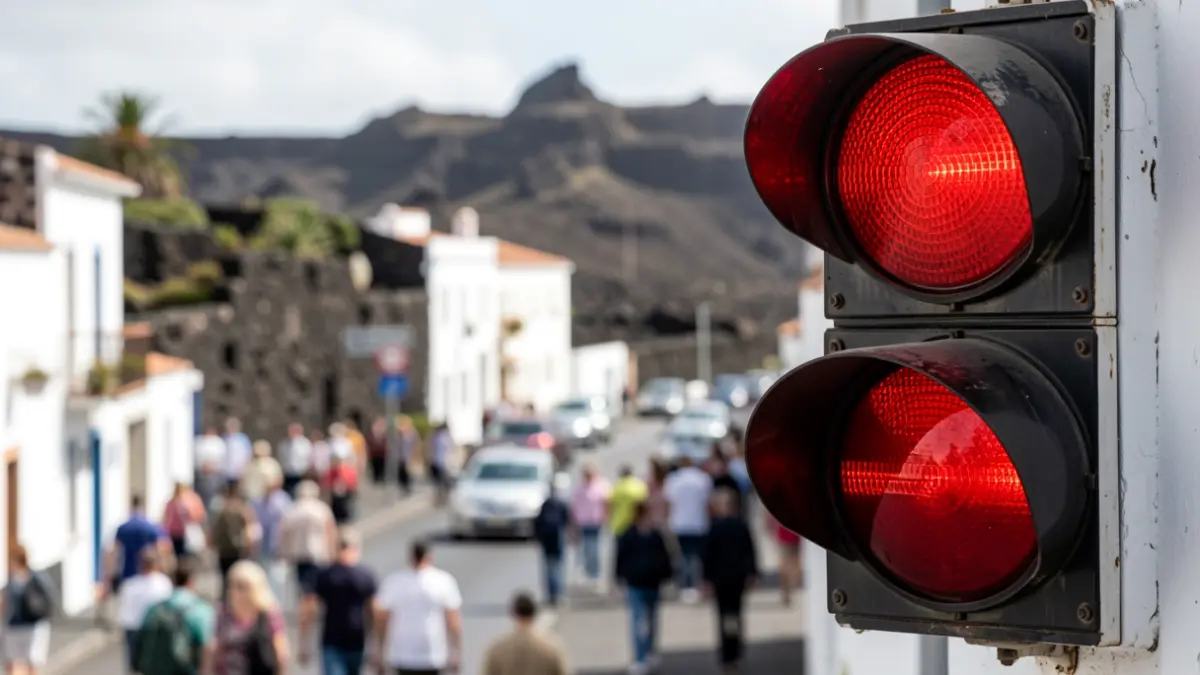
Ignoring the meaning of this warning can have significant financial consequences. Running a red light is considered a serious offense, punishable by a 200 euro fine and the deduction of 4 points from the driving license. The penalty applies whether the vehicle completely crosses the intersection or merely crosses the stop line while the light is red. The General Traffic Regulations clearly stipulate that, when facing a non-flashing red light, vehicles must stop before the nearest stop line.
These controls are common in urban areas with high traffic volume, regulated intersections, and zones where the coexistence of vehicles with pedestrians, public transport, and other road users requires special attention. In the Canary Islands, cities such as Santa Cruz de Tenerife, La Laguna, Las Palmas de Gran Canaria, Arrecife, Puerto del Rosario, as well as tourist municipalities in the south of Tenerife and Gran Canaria, feature this type of signage on their urban roads.
Proof of the offense can be provided by an authority agent or through automatic systems. Red-light cameras capture image sequences of the offending vehicle, showing its position before and after the stop line with the traffic light red. These systems are usually preceded by a blue vertical sign, such as the S-991c.
Regarding the amber light, the general rule is to stop, unless the vehicle is so close that a sudden brake could pose a risk. Accelerating to cross before it turns red not only increases the risk of an accident but can also result in a fine if the line is crossed when the light is already red.
The combination of increased traffic, drivers unfamiliar with the routes, and travel to high-traffic areas during holidays underscores the importance of attention at the wheel in the Canary Islands. Knowing the S-991c signal, respecting traffic lights, and reducing speed when approaching intersections are key to avoiding penalties and risky situations.