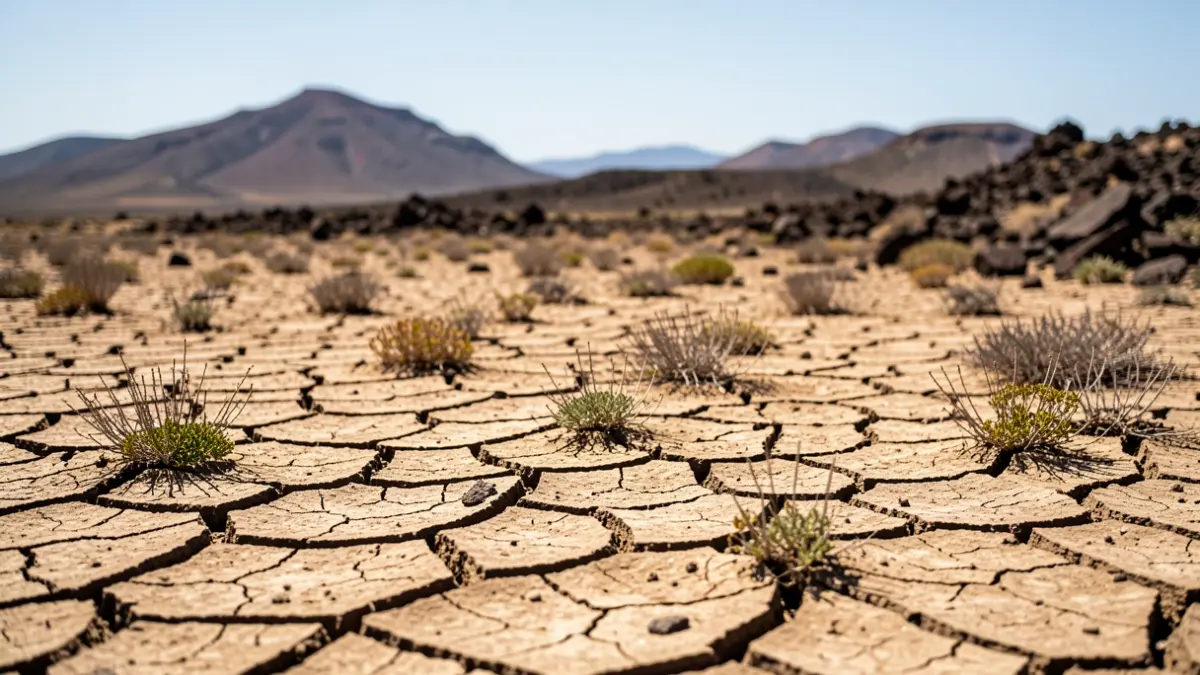
Water availability in the Canary Islands is set to progressively decline throughout the 21st century. This trend is attributed to a combination of rising average temperatures, increased evapotranspiration, and precipitation levels that will remain stable or even decrease. This is the main conclusion of a study conducted by the University of La Laguna (ULL).
The research, titled 'Island water stress: analyzing Canary Island's hydrological response to climate change' and published in the journal Environmental Monitoring and Assessment, analyzes the long-term impact of climate change and human activity on the archipelago's natural water resources. The study was coordinated by professor Juan Carlos Santamarta Cerezal, from the ULL's Department of Agricultural Engineering and Natural Environment.
The work focuses on the climatic water balance, an indicator solely dependent on climate, calculated from precipitation (water input) and evapotranspiration (water removal). This method, which excludes contributions like desalination, specifically isolates the effect of climate change on water resources, as explained by the university.
The research team adapted the Ficlima methodology to the islands, achieving a resolution of 100 meters, the highest level of detail to date for the archipelago. This technique is supported by the global climate models from the Sixth Assessment Report of the IPCC (Intergovernmental Panel on Climate Change of the United Nations).
Projections have been made for three time horizons (short, medium, and long term) and under various greenhouse gas emission scenarios. Added to the climatic pressure is human activity, particularly population growth and the high water demand from tourism and agriculture.
The general trend observed is a decrease in the climatic water balance, which intensifies as the century progresses. Coastal areas already show a zero balance, increasing water stress across the territory. The western islands, despite having greater current availability, anticipate more pronounced percentage decreases. In El Hierro, reductions could range between 50% and 75% by the end of the century. Tenerife estimates a decrease of approximately 50% (equivalent to 50 to 100 mm less available water).
Fuerteventura and Lanzarote, already arid, will see their scarcity worsen. In Gran Canaria, an almost complete depletion of reserves is projected, currently limited to small mountainous areas in the north and center. The general trend for the archipelago is decreasing.
Researchers emphasize the usefulness of this data for more efficient water management, given the competition for water between highly demanding sectors like tourism and agriculture. Strategies such as seawater desalination, wastewater reuse, and improvements in storage and distribution already help mitigate scarcity, although they face challenges in efficiency and energy consumption.
The study proposes measures such as strengthening water production with renewable energies, implementing efficient irrigation techniques and drought-resistant crops, integrated tourism planning, and inter-island cooperation. The adoption of adaptive policies and a sustainable approach to water management will enable the Canary Islands to better face future scarcity and ensure the long-term viability of both natural ecosystems and human activities.
The results are available on the SICMA-Canarias platform. This project has recently received the 2026 Chris Binnie Award for Sustainable Water Management.