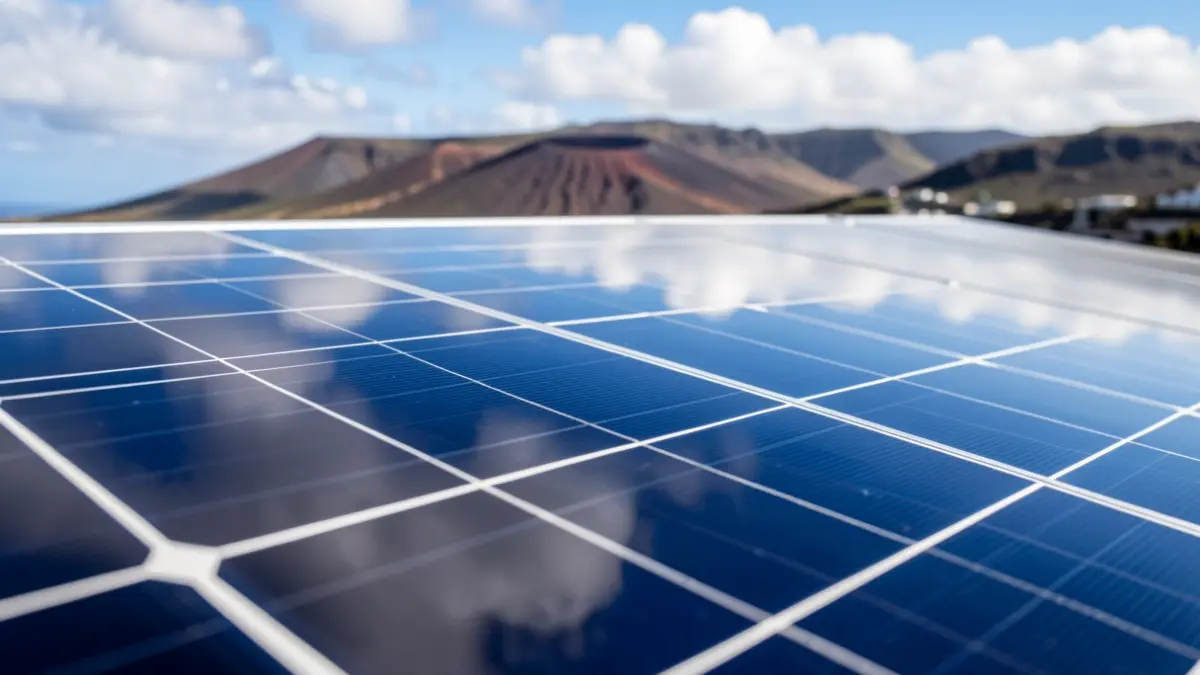
Canary Islands has reached the 100% milestone in processing European Union Next Generation funds, allocated for decarbonization and sustainable energy in the Islands. This translates to 313 certified actions and the installation of 85 megawatts of renewable power capacity.
Despite this achievement, the Minister of Ecological Transition and Energy of the Government of the Canary Islands, Mariano Hernández Zapata, has reiterated the request to the Central Government for an extension on the subsidy justification period. The aim is to prevent the return of 240 million euros to Brussels.
Zapata stated that a key milestone of the legislature in energy transition has been consolidated, ensuring compliance with Europe and the Canary Islands, after the deadline set by the Central Government on June 30th.
The pre-justification submitted to the Institute for the Diversification and Saving of Energy (IDAE) and the Ministry of Finance attests to the fulfillment of European objectives. However, the complete justification of all approved projects was not materially possible within the established timeframe, partly due to the sector's inability to undertake so many actions in a short period.
Metal industry associations, Femepa and Femete, point to the difficulty in increasing the work pace due to a shortage of suitable professional profiles. They warn that treating the archipelagos, like Balearic Islands which has joined the request, the same as the mainland is a mistake, given the slower pace of supplies and greater stock accumulation.
The amount managed by the Canarian and Balearic administrations, particularly the former, is significantly higher than in other regions, which has also shortened the available time for project execution and justification.
The European objective of installing 128 megawatts of renewables between both archipelagos by July 31st has already been surpassed, with 143 megawatts certified, of which 85 correspond to the Canary Islands, a figure expected to increase.
The IDAE has secured an additional two years from Europe for larger projects, such as geothermal exploration in Vilaflor, Tenerife. In light of this, the Islands advocate for keeping the window of opportunity open.
Zapata insists there are no excuses for not extending deadlines and allowing strategic projects to proceed without subsidies needing to be reimbursed. He points out that the decarbonization of the Canary Islands is part of the decarbonization of Europe.
In addition to the energy strategy, objectives for supporting energy transition actions have also been exceeded, with 313 certified compared to the initially assigned 287. In self-consumption, storage, and renewable thermal systems, the Canary Islands have pre-justified 140 megawatts, surpassing the committed 83.
Under the Moves III program (2021-2024), aid has been granted for 8,035 electric vehicles and 3,055 charging points in the autonomous community.