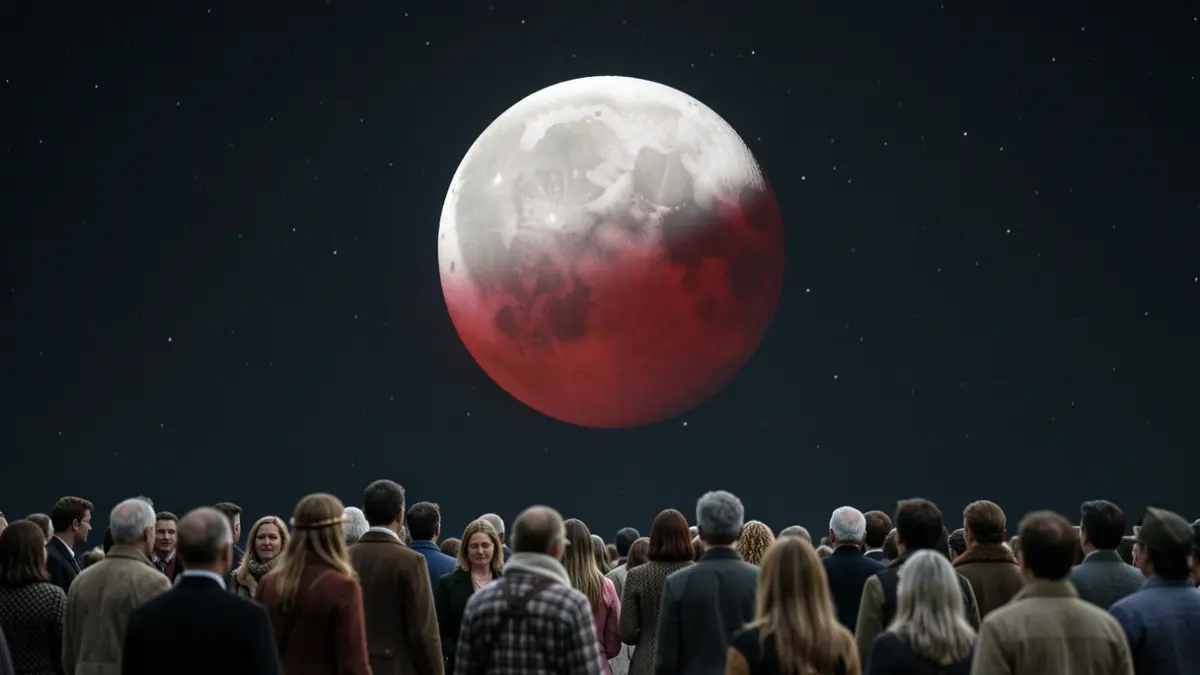
The most visible phase of the eclipse will begin around 3:34 AM in the Canaries, reaching its peak around 5:13 AM, when a significant portion of the lunar disk will be obscured by the Earth's shadow. The phenomenon does not require special eye protection and can be observed directly.
According to data from the National Geographic Institute (IGN), the partial phase will conclude around 6:52 AM. Unlike other regions of Spain, in the Islands the moon will set after this phase ends, allowing for a more complete observation of the event.
The lunar eclipse will have a magnitude of 0.93, indicating that a large part of the lunar disk will submerge into the umbra, the darkest part of the Earth's shadow. It is important to remember that the Canaries are one hour behind the Peninsula, so the start and peak times should be adjusted accordingly.
The penumbral phase, where the darkening is more subtle, will begin around 2:24 AM. However, the most striking moment for observers will be between 3:34 AM and 6:52 AM, with the climax around 5:13 AM, when the satellite will still be visible above the horizon.
Although the partial phase will be visible throughout Spain, the Canaries offer a prime location for its complete observation. The full moon on August 28 is the necessary condition for this type of eclipse, which occurs when the Earth is positioned between the Sun and the Moon.
Unlike solar eclipses, lunar eclipses pose no risk to vision and do not require special equipment, although binoculars or telescopes can enhance the appreciation of details. The part of the moon within the Earth's shadow may acquire reddish or orange hues due to the scattering of sunlight in the Earth's atmosphere.