The Ministry of Ecological Transition and Energy of the Government of the Canary Islands is developing the first regional network of climate shelters. The objective is to provide citizens with safer and more comfortable public spaces during extreme heat episodes, with special attention to protecting the most vulnerable groups.
The Vice-Minister of Ecological Transition, Fight against Climate Change and Energy, Julieta Schallenberg, met with representatives of the Hotel and Extra-hotel Association of Tenerife, La Palma, La Gomera and El Hierro (Ashotel) to coordinate the adhesion of their network of climate shelter hotels to the regional initiative. This network, to be presented soon, aims to identify safe spaces on all islands that meet technical requirements to cope with heatwaves and the consequences of climate change.
Julieta Schallenberg highlighted that the Canary Climate Shelter Network is a pioneering initiative designed to protect the population from the increasingly frequent effects of heatwaves. She explained that a network based on homogeneous technical criteria is being built, which also seeks collaboration from sectors committed to climate change adaptation and people's well-being.
The Vice-Minister emphasized the joint work with Ashotel, whose proposal is being considered as a potential line of private collaboration. The hotel association's involvement, with its track record in sustainability and environmental efficiency, will add value to the project. The goal is to integrate private initiatives that meet the established technical criteria, thereby expanding protection spaces.
The Canary Islands thus become the first Autonomous Community to develop a regional network of climate shelters and to provide municipalities and island councils with a common methodology for planning more resilient cities. The network will not only inventory existing spaces but will also implement a methodology to progressively identify, evaluate, and improve locations with better environmental conditions against high temperatures.
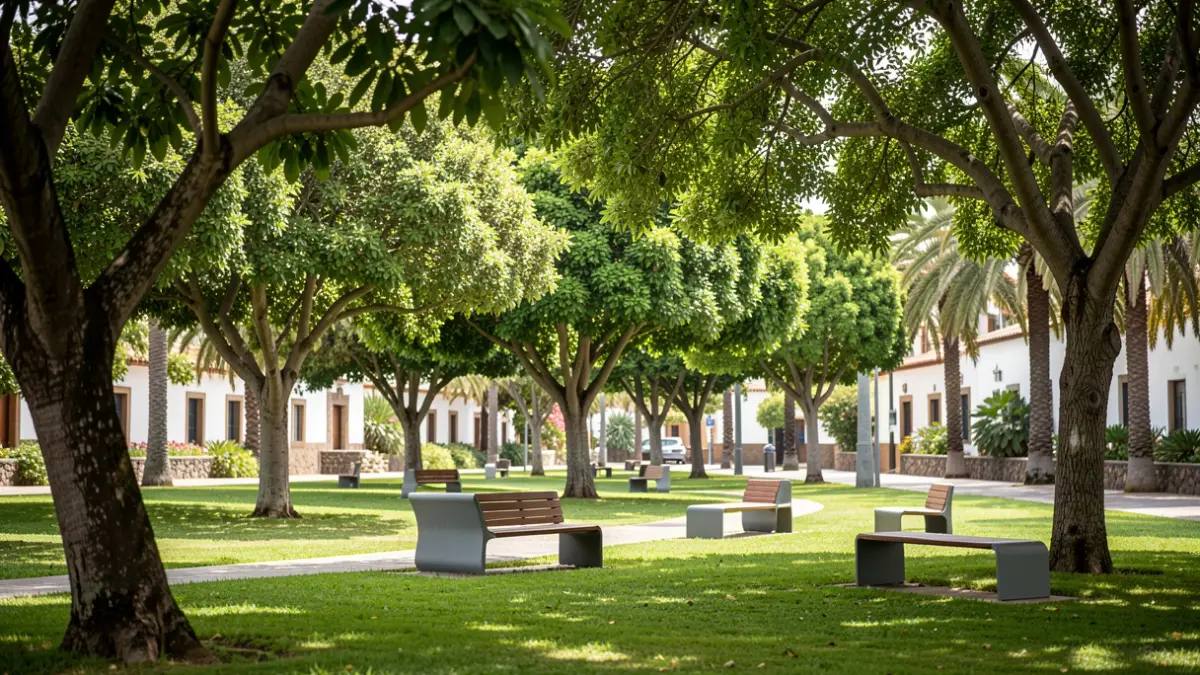
The Government of the Canary Islands has distributed the technical guide “Recommendations for the creation of green spaces as climate shelters” to all municipalities and island councils. This document provides homogeneous criteria for designing new shelters and adapting existing ones. Requirements include sufficient shade, rest areas, free drinking water, accessibility, adequate opening hours, and appropriate thermal comfort conditions.
Technical work has identified over 750 potential climate shelters in more than 70 municipalities. Currently, 49 municipalities have indoor shelters and 50 have outdoor shelters or adapted green areas. The project is dynamic, and the inventory will expand as local administrations incorporate new spaces. The Ministry collaborates with the Canary Federation of Municipalities (FECAM) for the dissemination of these spaces.
The next phase of the project is to make this information available to the public. The Government of the Canary Islands is working with GRAFCAN on a cartographic viewer and a mobile application to locate the nearest climate shelter. These tools will offer details on location, opening hours, free drinking water, restrooms, accessibility, and routes.