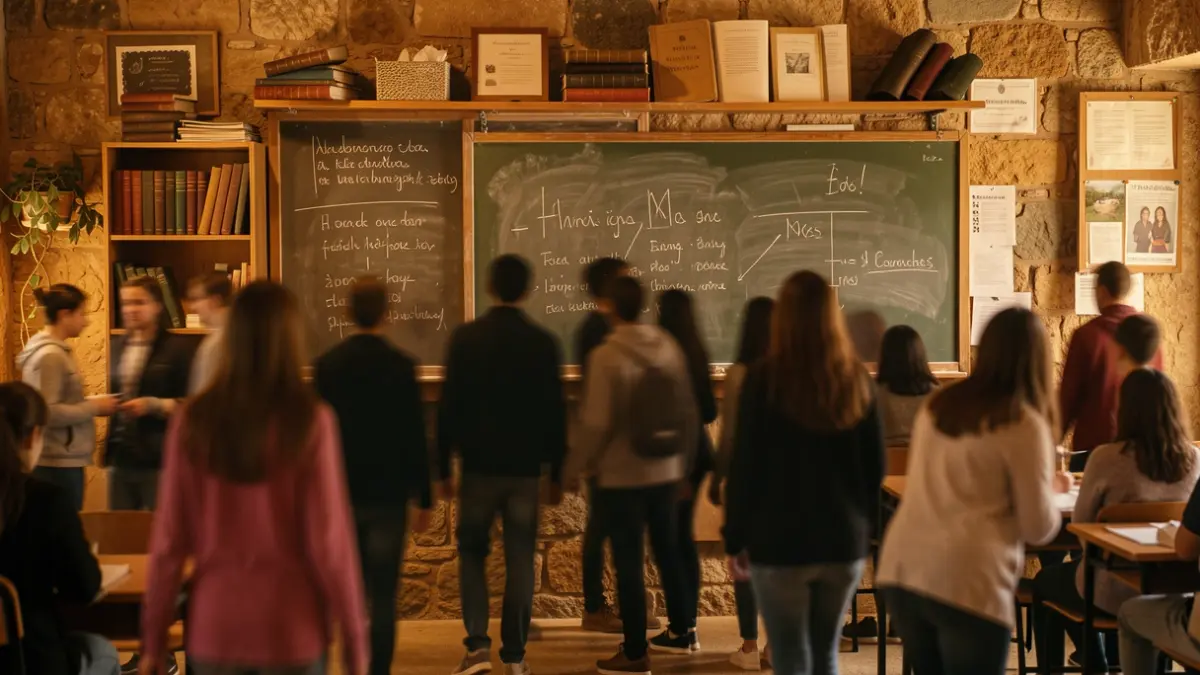
The population of study age in the Canary Islands, aged between 6 and 24 years, will decrease by 19% by the year 2041. This figure is 5.3 percentage points higher than the national average of 13.7%. Demographic projections from the National Statistics Institute (INE) estimate that this reduction will mean a loss of 1.32 million potential students across Spain.
This trend is directly linked to low birth rates, a phenomenon impacting all educational levels and autonomous communities, albeit with varying intensity. Adding to this demographic challenge is the aging of the teaching staff, with 35% of secondary school teachers already over 50 years old.
This is revealed in the report 'Esenciales nº 3', published by Fundación BBVA and the Valencian Institute of Economic Research (Ivie). The study emphasizes the need for an 'adapted reorganization' of educational resources at each level and autonomy to 'sustain educational quality' amidst growing public spending pressures on healthcare and pensions, stemming from population aging.
The Canary Islands ranks as the seventh autonomous community projected to lose the most population aged 6 to 24, following Ceuta (34.5%) and Melilla (33.4%), Extremadura (23.1%), Cantabria (22.8%), Galicia (19.4%), and the Basque Country (19.1%). In contrast, the Valencian Community anticipates a reduction of only 5%.
On the islands, the decline will be more pronounced among 16 and 17-year-olds (28.1%), affecting post-compulsory secondary education such as Baccalaureate or Vocational Training. Compulsory education (6-15 years) will see a 20.1% decrease, and higher education (18-24 years) a 15.6% drop. The sole exception is the 0-5 age group (early childhood education), which is expected to grow by 4.3%, a trend mirrored nationwide.
At the state level, compulsory and post-compulsory secondary education will be the most affected, with a projected drop of 21.5% by 2041. In primary education, a decrease of 14.5% is estimated until 2035, followed by stabilization. Higher education will experience a less drastic fall (8.7%), as the reduction in the 18-24 age group is expected later, from 2032 onwards.
This demographic scenario could increase public spending per student, particularly in post-compulsory studies. The report estimates university spending at 11,347 euros per student, 5,806 euros for Vocational Training, and 4,720 euros for early childhood and primary education. Conversely, a 7.5% growth is projected in the population under 6 years old, and an 18% increase in children aged 0 to 2, boosting demand for early childhood education.