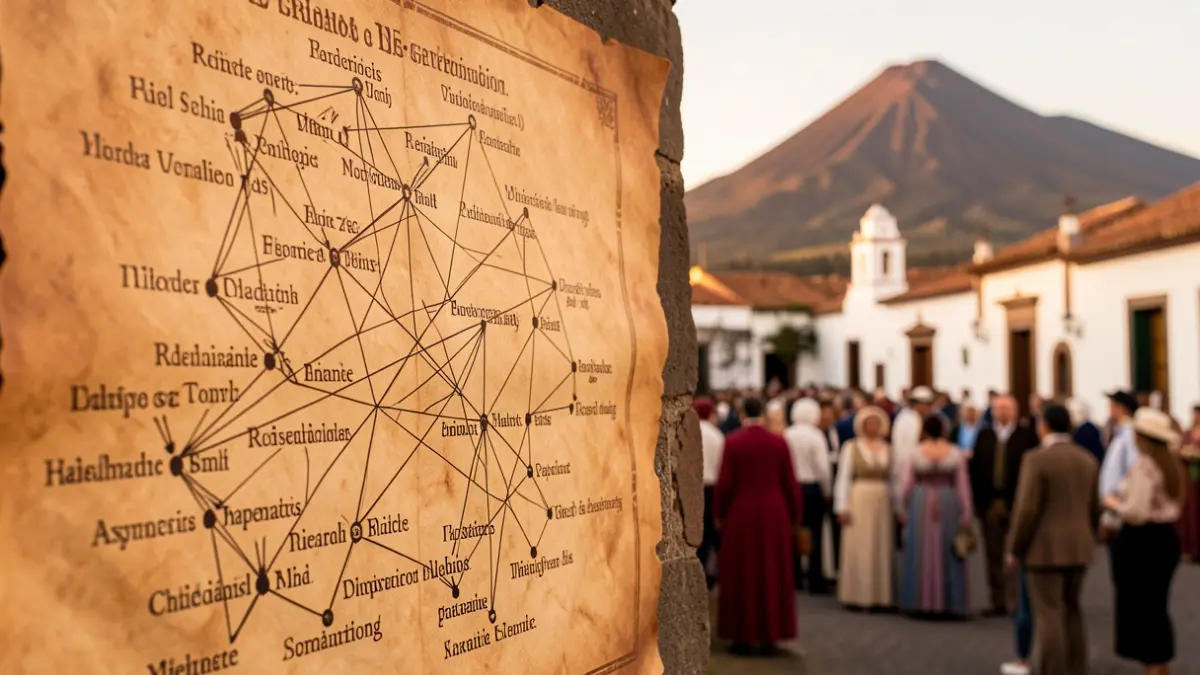
The study, titled Canary Ancestors of His Holiness Pope Leo XIV, was prepared by genealogist María Carrillo de Albornoz Santana, secretary of the Society of Genealogical and Heraldic Studies of the Canary Islands, commissioned by the Government of the Canary Islands. The work reconstructs the history of two families, the González Vázquez and the Hernández Pérez, established in Santa Cruz de La Palma during the 16th and 17th centuries, linked to fishing and the La Asomada neighborhood.
The research documents the union of these two family branches through the marriage of Gaspar González and María Pérez, celebrated on January 5, 1614, at the parish of El Salvador in Santa Cruz de La Palma. From this union, Juan González Vázquez was born, whose genealogical line later connects, after his presence in Cuba, with that of Pope Leo XIV.
The Deputy Minister of the President's Cabinet, Octavio Caraballo, emphasized that the gift "has profound significance because it directly connects with the central theme of the Pope's visit to the Canary Islands and with a reality that is part of our collective identity: migration." He highlighted that the study "confirms that His Holiness's origins are in the Canary Islands, in a family history that, like that of so many Canarians, was marked by journeys, displacements, and connections built on both sides of the Atlantic."
Carrillo de Albornoz's research is based on original documentation from the sacramental books of the parish of El Salvador in Santa Cruz de La Palma. The work identifies María Pérez, baptized on August 12, 1587, as the Pontiff's tenth great-grandmother. The work also describes the social context of these families, linked to the fishing trade in Santa Cruz de La Palma during the 16th and 17th centuries.
The project that the Holy Father will receive includes, in addition to the genealogical study, a canvas depicting the thirteen generations of Pope Leo XIV and a hardcover book with the baptismal and marriage records of his Canarian ancestry. Carmelo Santiago, representative of Editorial Genealógica Canaria, explained that the canvas "is full of symbolism" and that the book incorporates the Cross of San Agustín and the flag of the Canary Islands.
The Bishop of the Nivariense Diocese, Eloy Santiago, expressed his satisfaction with these "gifts that the Government of the Canary Islands wishes to offer the Holy Father," highlighting the "wonderful research" that involved eight genealogists from different countries and which "will reveal the connections that Pope Leo XIV has with the Canary Islands."
The Presidency of the Government of the Canary Islands considers that this institutional gift holds special symbolic significance, recalling "our history full of round trips, of families separated by the ocean and reunited by memory." Octavio Caraballo added that certifying the Pope's Canarian roots today "is also a way of vindicating that shared history and remembering that behind every migration there are people, families, hopes, and opportunities."
Along with the genealogical study, the Government of the Canary Islands will present an artisanal piece commissioned from the Association of Caladoras of the Villa de Ingenio, in Gran Canaria: a tablecloth over three meters long, an alb and a personalized stole. This work symbolizes the delicacy, identity, and continuity of a craft that is part of the intangible heritage of the Islands.