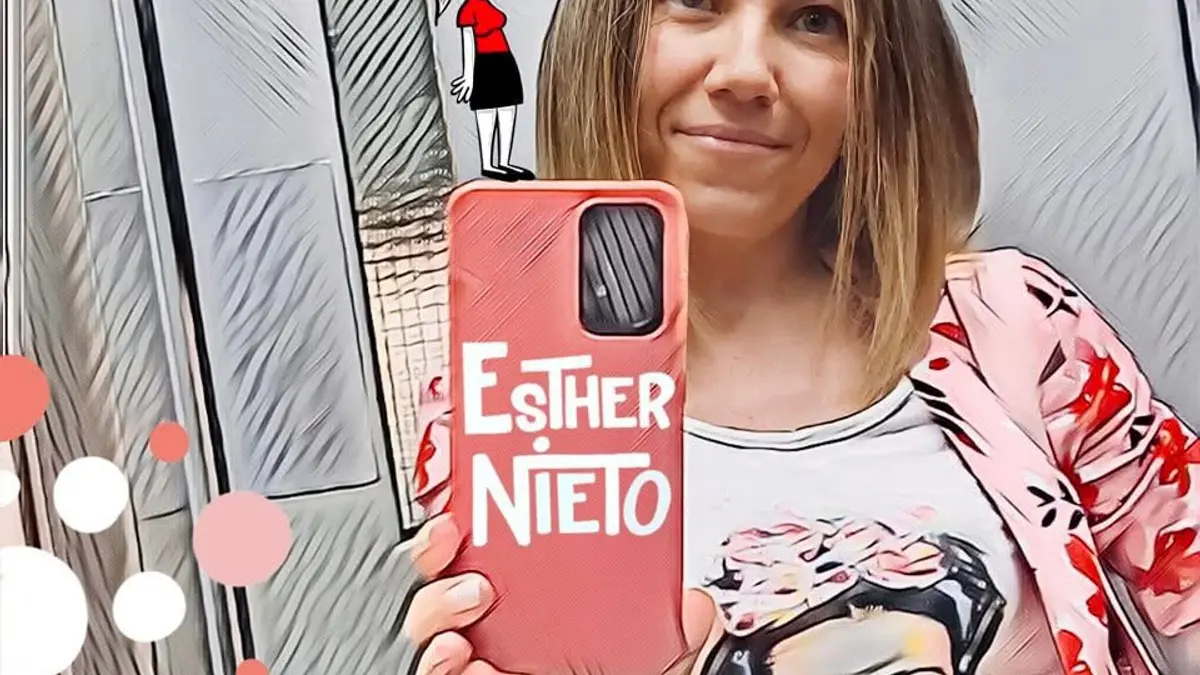
Esther Nieto, a plastic arts teacher and artist by vocation, born in Córdoba but based in Gran Canaria, has found in cartooning a means of escape and reflection. Her creations, marked by red and black, address current events, social criticism, and humor, often focusing on the reality of the Canary Islands, such as housing issues.
For years, Nieto explored her artistic side by reinterpreting famous paintings, even exhibiting her versions. However, she felt the need to explore new languages, discovering graphic humor on February 14, 2024, with her first cartoon titled Amor (Love). This leap, initially marked by fear, has settled into a weekly creative routine.
Her visual signature is unmistakable: the predominant use of red and black, and a nameless protagonist who acts as an alter ego and universal mirror. This figure, always dressed the same, has become a symbol of her work, representing many and even prompting jokes about her 'limited wardrobe'.
Despite the passion she dedicates to it, Nieto acknowledges the difficulty of living solely from cartooning in the Canary Islands. Most professionals in the sector, as she notes through cartoonist associations, combine this activity with other jobs. Although exhibitions, commissions, and social media help with dissemination, cartooning remains a demanding passion.
Social media presents a double-edged sword: it allows her to showcase her work but also demands a degree of self-censorship due to the possibility of platform censorship or public reaction. Nieto recalls fearing censorship for a cartoon referencing France and the word 'liberté'.
The rise of artificial intelligence also concerns Nieto, who has dedicated years of self-taught effort to perfecting her technique. She believes AI devalues the work of a cartoonist, although she acknowledges it cannot replace the creative process, concentration, and personal care involved in drawing, defining it as 'therapy' for which there is no artificial intelligence.