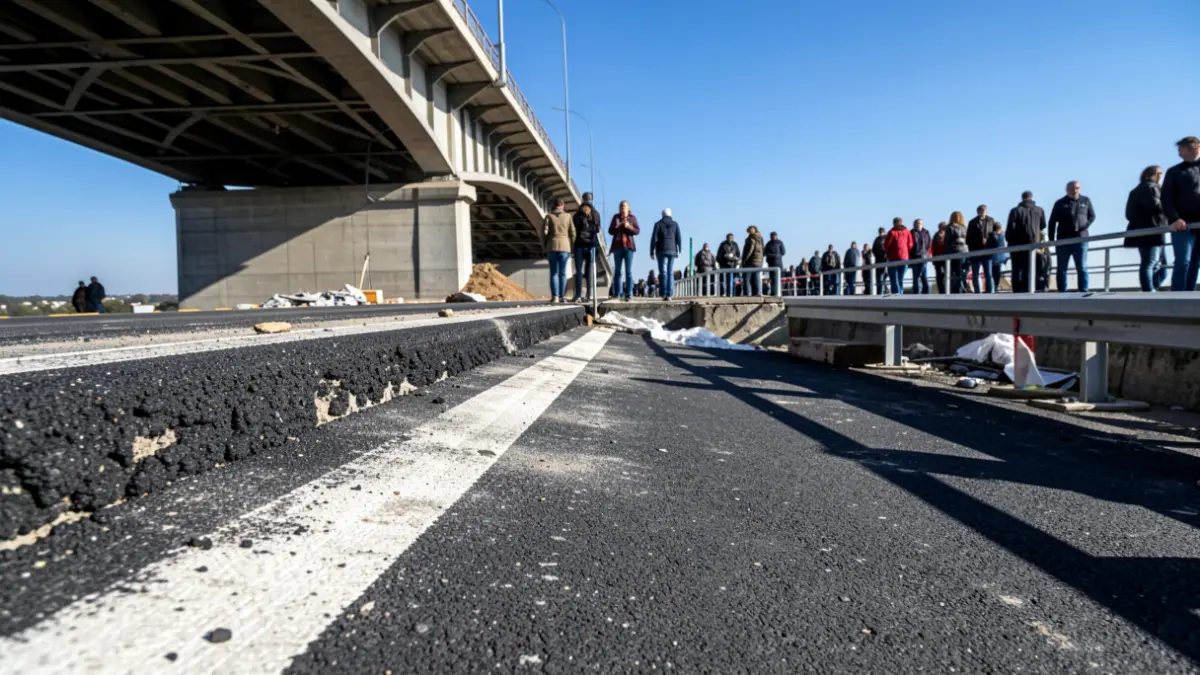
Traffic on the northbound lane of the Guiniguada Viaduct in Las Palmas de Gran Canaria will reopen this Sunday the 9th, a week ahead of the initially scheduled date. This advancement is attributed to the "tremendous effort" by the workers involved in the waterproofing process.
This was confirmed on Friday by Augusto Hidalgo, Minister of Public Works for the Cabildo of Gran Canaria. On the same Sunday, the GC-3 will be closed in the southbound direction, with the aim of reopening it within 15 days. Consequently, traffic pressure will shift to the Julio Luengo tunnel heading south starting this Sunday.
The works, awarded to the contractor Lopesan, included milling the asphalt layer to a depth of 10 centimeters. The waterproofing, which the bridge lacked since its construction, was carried out by installing asphalt membranes welded at high temperatures by the company Smart Working Canarias. Over 18,000 square meters will be waterproofed across the viaduct's two decks.
To further expedite the timeline, the Ministry of Public Works agreed to double the work shifts, employing up to 20 specialized operators simultaneously, compared to the usual five or six for such tasks.
Despite adverse weather conditions, including high heat and humidity, the workers labored intensely. A total of 2,500 rolls of asphalt membranes, weighing 120 tons, will be deployed, along with 300 propane cylinders. The asphalt used is of the highest market quality, similar to that used on AVE high-speed rail bridges.
In addition to waterproofing, expansion joints connecting the bridges to the land, designed to absorb movement from material expansion or contraction, have been replaced. Each joint comprises ten polyethylene modules and steel plates.
Following the completion of waterproofing on the northbound carriageway, Lopesan will resurface this section between Friday and Saturday for its reopening. A final wearing course will be applied later in both directions during nighttime hours to minimize traffic disruption.