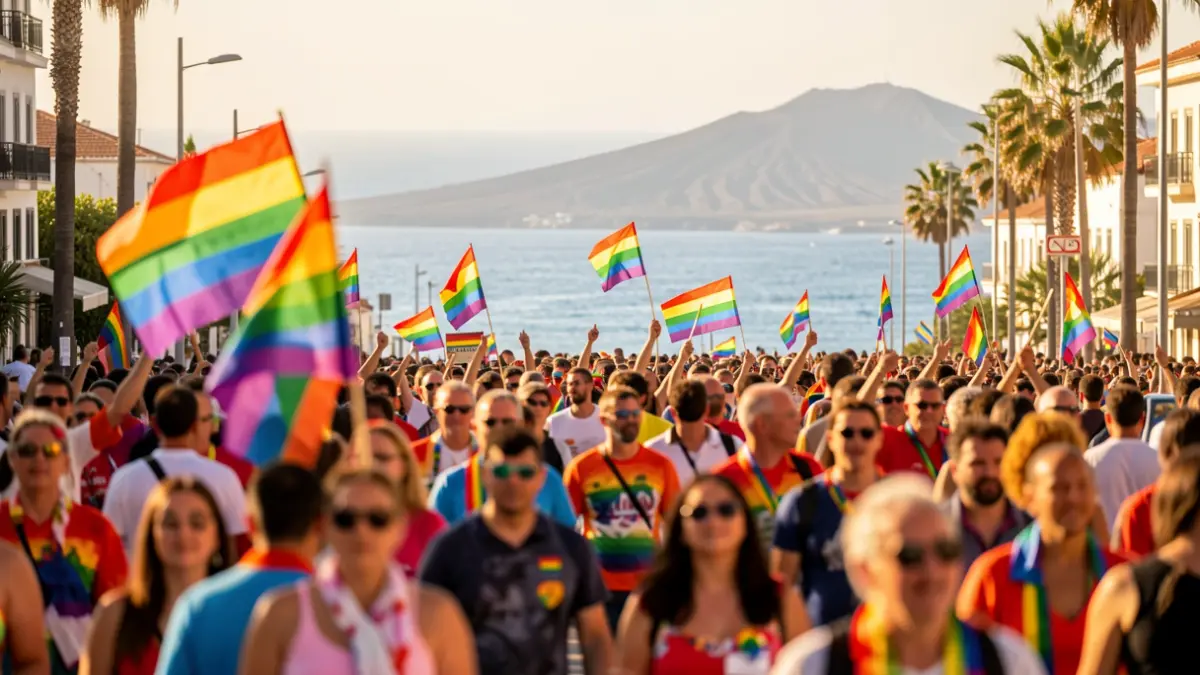
Every June 28th, the Canary Islands are adorned with rainbow colors to commemorate LGTBIQ+ Pride Day. Streets become stages for protest and historical remembrance, fostering necessary visibility. However, beneath the celebrations lies a reality where many in the community feel unprotected by institutions and fear expressing their identity, a fear amplified by the surge of the far-right and the normalization of hate speech.
Pride transcends mere celebration, serving as a reminder that hard-won rights are not irreversible and require constant defense. Diversity, it is argued, must be protected and exercised freely 365 days a year. Emma Colao, director of the Social Rights Observatory of the Canary Islands, criticizes institutional 'pinkwashing', noting that some administrations flying the LGTBI+ flag also fund organizations promoting opposing views.
Colao also questions the prevailing celebration model in the islands, deeming it exclusionary for lesbians, trans individuals, non-binary people, or those of color, and laments the absence of a critical protest recalling the movement's origins. The 028 helpline for LGTBIphobia support received 1,448 consultations in the Canary Islands between July 2023 and May 2025, positioning the archipelago as the third autonomous community with the highest number of interventions.
“"When the flags come down, and we return to the reality of our daily lives, there is still hate, discrimination, and we continue to suffer insults and aggressions."
Sergio Siverio, spokesperson for the association Diversas, describes a dual reality in the Canary Islands: a festive, safe bubble versus a daily life marked by hate and discrimination. Nevertheless, he sees optimism in the high number of hate crime reports, interpreting it as a more aware and mobilized society that will not tolerate injustice. "It must be see, hear, and fight," he asserts.
The political growth of the far-right and the rapid spread of hate speech on social media and in the press particularly concern those who have dedicated their lives to fighting for LGTBIQ+ rights. Fran Barroso, co-founder of Diversas, born in 1961, expresses his pain over the regression in freedoms, recalling the end of the Franco dictatorship. He highlights the harsh reality of older individuals having to hide their identity upon entering care homes.
Montserrat González, president of the Gamá association in Gran Canaria, describes the current situation as 'dark,' worrying about future generations. Despite this, she remains hopeful: "We will not go back to how it was; we will not allow it. We must continue fighting to not lose what we have achieved," she emphasizes.
This concern is not exclusive to older generations. Eva Hernández, an activist with Diversas, notes fewer safe spaces and an increase in discriminatory comments, even within her own circle. "Hate makes a lot of noise," she stresses, pointing to social media as amplifiers of intolerance.
From the perspective of a trans man, Álex Manuel of the Gamá association, the approval of the trans law is a significant advancement, though he acknowledges its increased visibility has brought criticism and attacks. He appreciates institutional educational support but stresses the need for more training for healthcare professionals: "A law that does not invest money in training professionals is a piece of paper," he states.
Once Pride concludes, those who have raised their voices cannot afford to rest. The testimonies gathered, from different times, share a common goal: freedom.