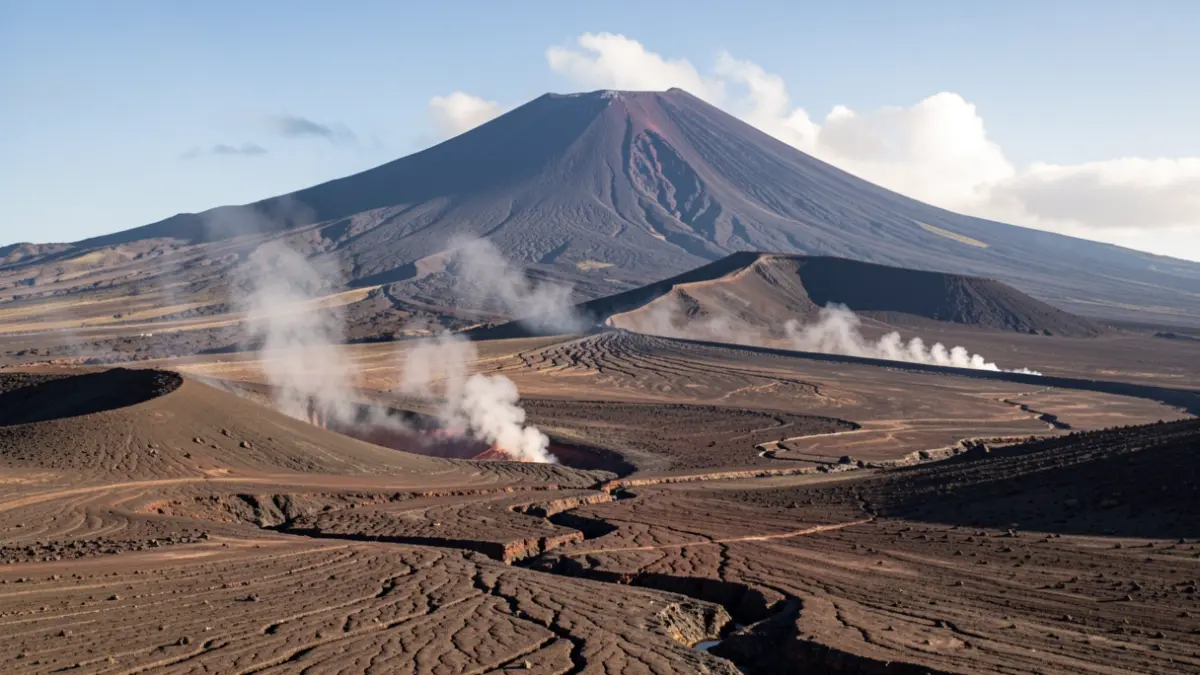
The National Geographic Institute (IGN) has reported the detection of several seismic-volcanic activity pulses beneath the island of Tenerife. These events have been concentrated mainly in the area west of Las Cañadas del Teide. Despite the attention generated among experts, the agency has emphasized that this activity does not increase the risk of a volcanic eruption in the short or medium term.
Data collected between June 18 and 19 details that seismic activity began on Wednesday at 5:14 AM with an 11-minute episode that located 16 earthquakes. These occurred at depths between 8 and 17 kilometers below sea level, with magnitudes ranging from 0.6 to 1 mbLg, as communicated by the IGN on its social media channels.
Subsequently, starting at 4:42 PM, a more prolonged seismic sequence began, extending throughout the afternoon, night, and early morning until 5:21 AM on Thursday. During this period, the IGN's automatic systems registered 63 seismic events, of which 14 could be precisely located.
The recorded seismic movements are situated between 8 and 15 kilometers in depth, with magnitudes between 0.4 and 0.8 mbLg. The majority of the hypocenters are concentrated in the western sector of Las Cañadas, an area that has experienced similar episodes previously. Additionally, a small earthquake of magnitude 0.3 mbLg was detected in Icod de los Vinos, at a depth of only two kilometers.
Experts point out that this activity shows similarities to that observed in February and March of this year, albeit with lower energy. These are low-frequency hybrid events, without a clear repetitive pattern and, in all cases, imperceptible to the population.
The IGN emphasizes that these types of signals are part of the normal dynamics of an active volcanic system like that of Tenerife and do not indicate significant changes in the volcano's evolution. The island remains under constant surveillance through a network of over 100 monitoring stations. The disseminated data is provisional and will be reviewed.