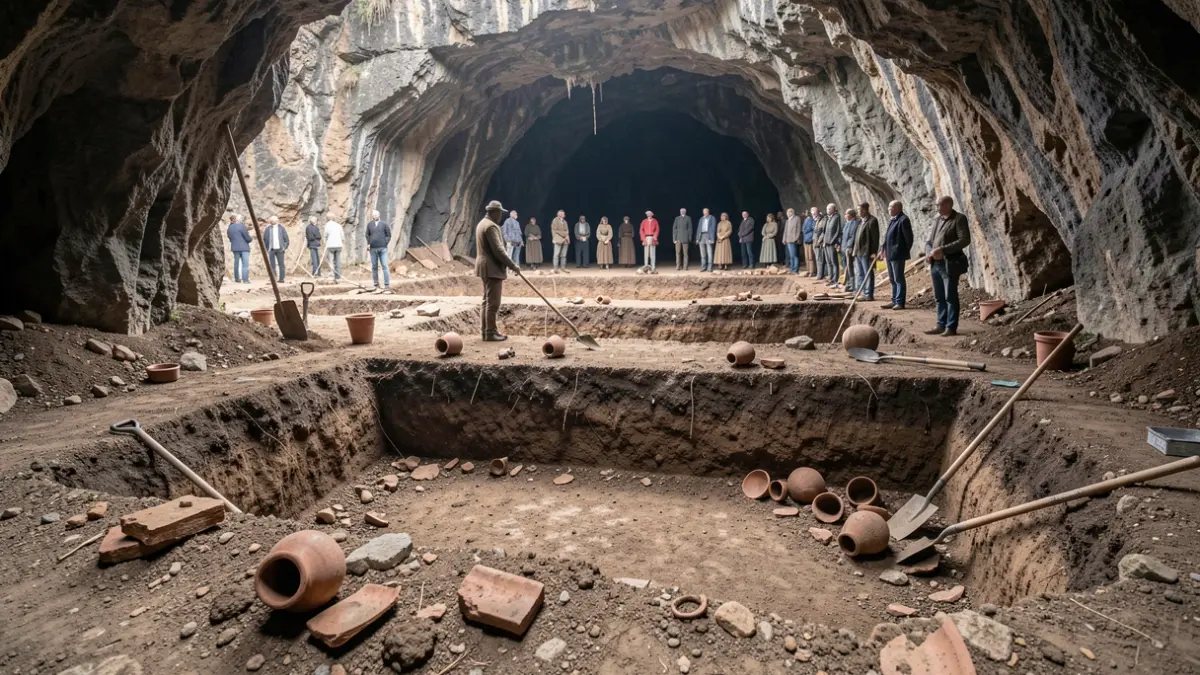
The Directorate General of Culture and Cultural Heritage, in collaboration with the Buenavista del Norte City Council, is conducting an excavation in a cave within the El Palmar Ravine. The aim is to study the persistence of the Guanche way of life and the acculturation process following the conquest. The large cave features 16th-century datings, demonstrating that the indigenous population continued their daily, livestock, agricultural, and even funerary activities in this area of the Daute region.
The research focuses on the continued use of the mid-altitude zone of Buenavista del Norte by the Guanche society. Nearly forty caves with residential and funerary functions have been identified in the Valley. Until now, absolute datings were only available for the municipality's coastal strip, one of the oldest on the island. This new intervention will allow for comparison and precise determination of the aboriginal occupation of the mid-altitude areas.
The Director General of Culture and Cultural Heritage, Miguel Ángel Clavijo, and the mayoress of Buenavista del Norte, Eva García, visited the cave along with the research team, co-directed by Efraín Marrero and Ithaisa Abreu from the specialized company PRORED.
“"The Guanche people survive after the conquest process. Chronicles and other preserved historical documents certify this, but now archaeological science corroborates it. Through this research, we will have more information about the history of our ancestors and also about how that transition period unfolded."
Eva García highlighted Buenavista del Norte's commitment to heritage work and thanked the Directorate General of Culture and Cultural Heritage of the Government of the Canary Islands for supporting initiatives that recover and value the municipality's heritage.
Efraín Marrero, co-director of the research, noted that the Daute region was the last to succumb to the conquest in the 15th century. Therefore, sites like this allow observation of the indigenous archaeological footprint alongside the coexistence with new settlers, reflecting the resistance of part of the Guanche population.
One of the most significant findings is a large combustion structure used for daily food cooking. Sedimentological analysis of the ashes from this hearth will allow for investigation into the cave's soil formation and verification of the space's usage antiquity. It will aim to confirm whether barley cultivation, documented in contemporary sources, continued after the conquest, as El Palmar was one of the few Guanche cultivation sites.
Among the recovered archaeological materials are a clay bead, faunal remains (pig, goats), large ceramic vessels for containing food or liquids, and lithic tools made of obsidian and basalt. The study of these elements may indicate a population remnant in the Valley after the initial settlement in the old town of Buenavista, whose presence in these caves might have been permitted before their definitive ethnocultural disappearance.
This project aligns with the Government of the Canary Islands' commitment to the conservation and dissemination of the archipelago's historical legacy, in compliance with Law 11/2019, of April 25, on Cultural Heritage of the Canary Islands.