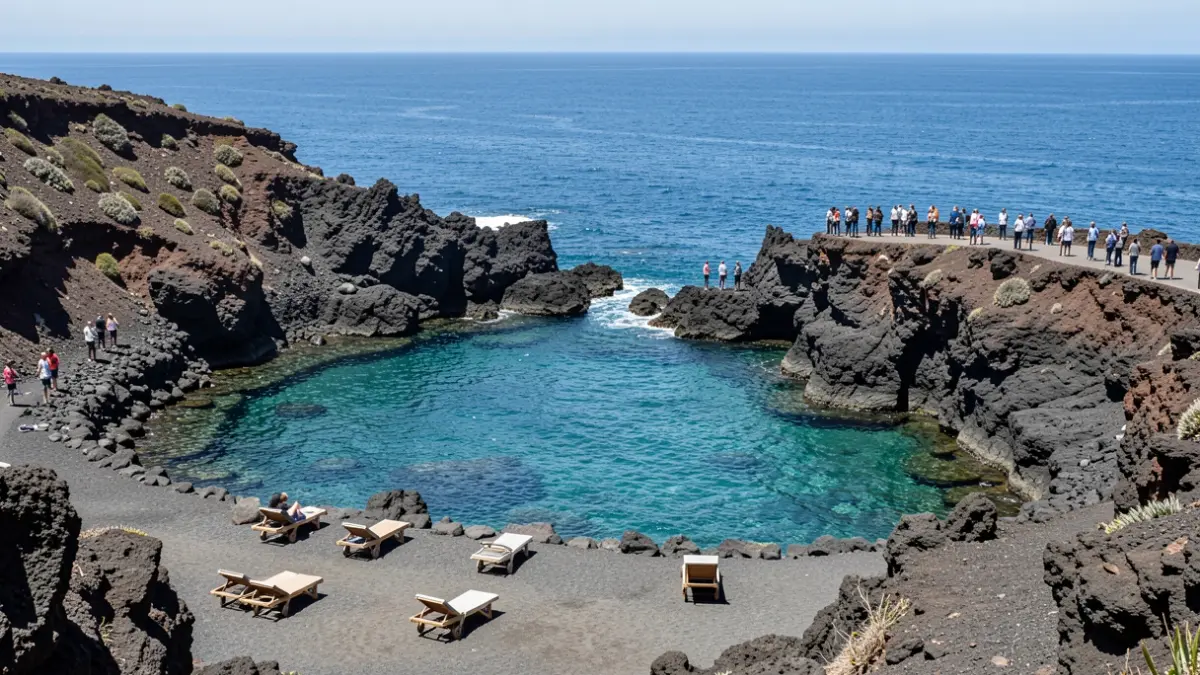
The Directorate General of Coasts has intervened to stop construction work undertaken by the El Pinar City Council in El Hierro, within the protected area of Tecorón. The project involved the installation of around 80 mobile sun loungers on cement platforms, along with parasols, and the creation of paths and other minor developments.
According to Magaly González, the council's Tourism Councilor, the public complaint filed by the platform Salvar Tacorón was a key factor in this change. Although the project had initial approval from Costas and the regional government, a specific permit related to the Special Protection Area for Birds (ZEPA) was missing, prompting Costas's intervention, which the councilor attributed "solely to the media complaint."
Earlier, the president of the El Hierro Island Council, Alpidio Armas, had announced the rectification of the action. After analyzing Costas's reasons and the lack of the ZEPA permit, the council decided to relocate the sun loungers, definitively ruling out the Tecorón area for this installation. The councilor expressed surprise at the Cabildo president's prior announcement.
Nature advocates and environmentalists had launched a social media campaign against the installation, arguing that protected land was being occupied and lava fields and gravel were being destroyed. They pointed out that the area is part of the ZEPA and hosts a colony of Cory's shearwaters, in addition to affecting the protected "snake's tongue" fern.
The naturalists criticized the "environmental damage" and the alteration of an "enclave of extraordinary geological and landscape value," describing the intervention as an "aggressive and disrespectful occupation" that degrades the island's landscape and territorial identity, an island designated as a geopark and Biosphere Reserve.
Island sources also indicated that, while the works were debatable, the council had made a good move by acquiring three plots in Tecorón previously owned by private families, thus incorporating key land into local public heritage. However, they stressed that the construction did not involve heavy machinery.