The Government of the Canary Islands has strengthened control measures against the Mexican cochineal (Dactylopius opuntiae) in El Hierro. Following 2,740 field inspections that detected 232 affected points, the Executive has provided the island council with a phytosanitary product for distribution among farmers and application on affected prickly pear cacti.
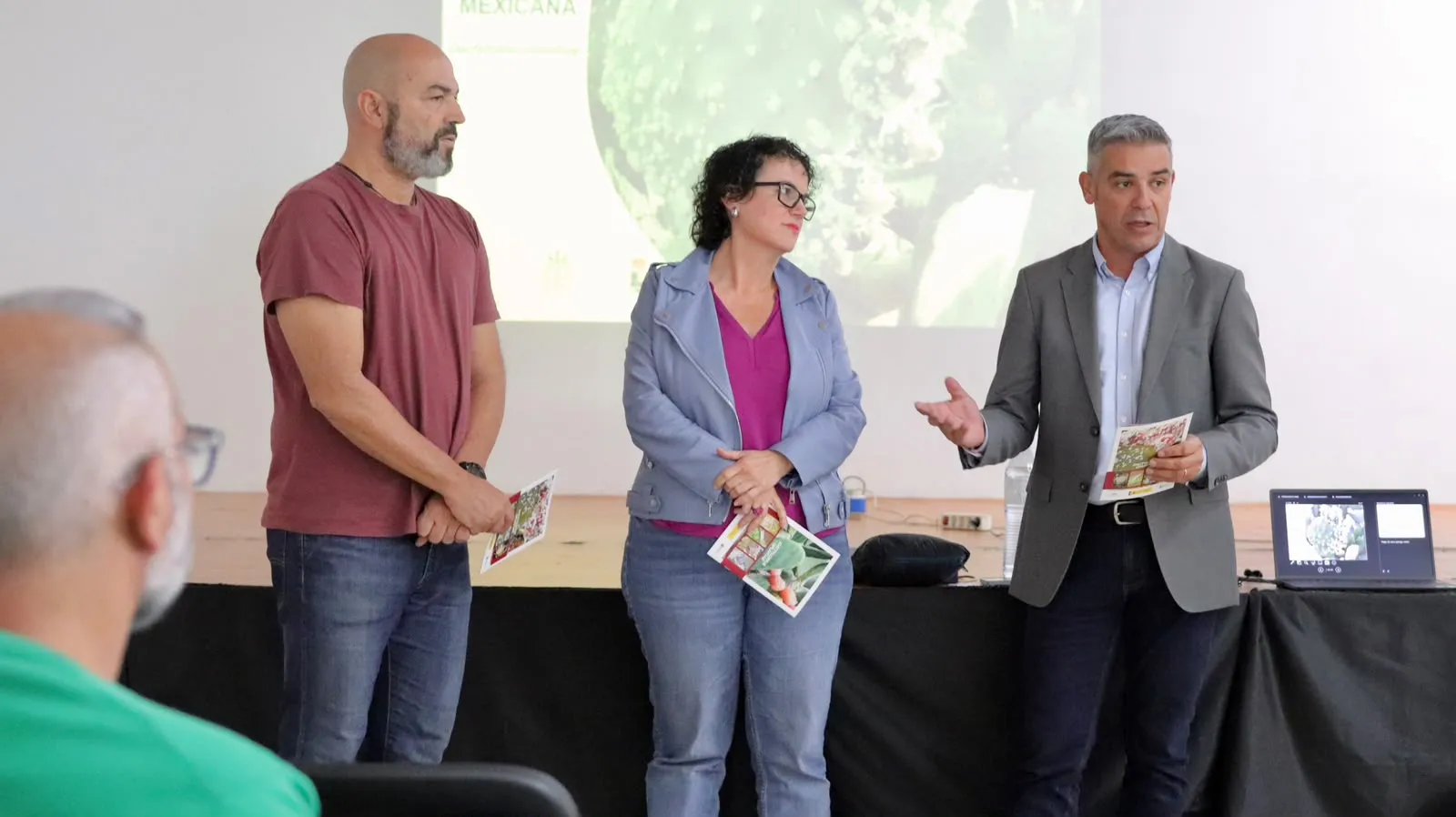
The Minister of Agriculture, Livestock, Fisheries, and Food Sovereignty, Narvay Quintero, participated in a technical workshop held at the Martín Arvelo Cultural Center in El Pinar. The event, organized by the Department of Agriculture, the Council of El Hierro, and with the collaboration of the Town Council of El Pinar, aimed to inform the primary sector about prevention and control measures against this pest.
The session was attended by Minister Narvay Quintero; the insular director of Rural and Marine Environment of the Council of El Hierro, María Jesús Molina; the coordinator of Agriculture at GMR Canarias, Nicolás Borges; the technician from the Council of El Hierro, Andrés Acosta; and the agricultural foreman of GMR, Eduardo Fajardo. The workshop was led by technical staff from the Plant Health Service and GMR Canarias.
The Mexican cochineal causes chlorosis, necrosis, and can lead to plant death. Early detection and the use of authorized phytosanitary treatments are crucial to minimize damage. Minister Quintero emphasized the importance of equipping farmers with tools to identify and act against the pest promptly.
The minister highlighted inter-administrative collaboration as key to a coordinated response. The Government of the Canary Islands has acquired 50 liters of OVIPRON, an authorized mineral oil, which has been transferred to the Council of El Hierro for distribution. These actions complement the prospecting and control efforts, which have involved an investment of 22,865 euros since early 2026.
Prospecting efforts, including 2,740 field inspections in April and July, identified 232 positive points, mainly in El Pinar (including Taibique and the paths towards La Restinga and Tacorón), and two near the Parador Nacional de El Hierro in Valverde. In July, phytosanitary treatments were carried out in El Pinar.