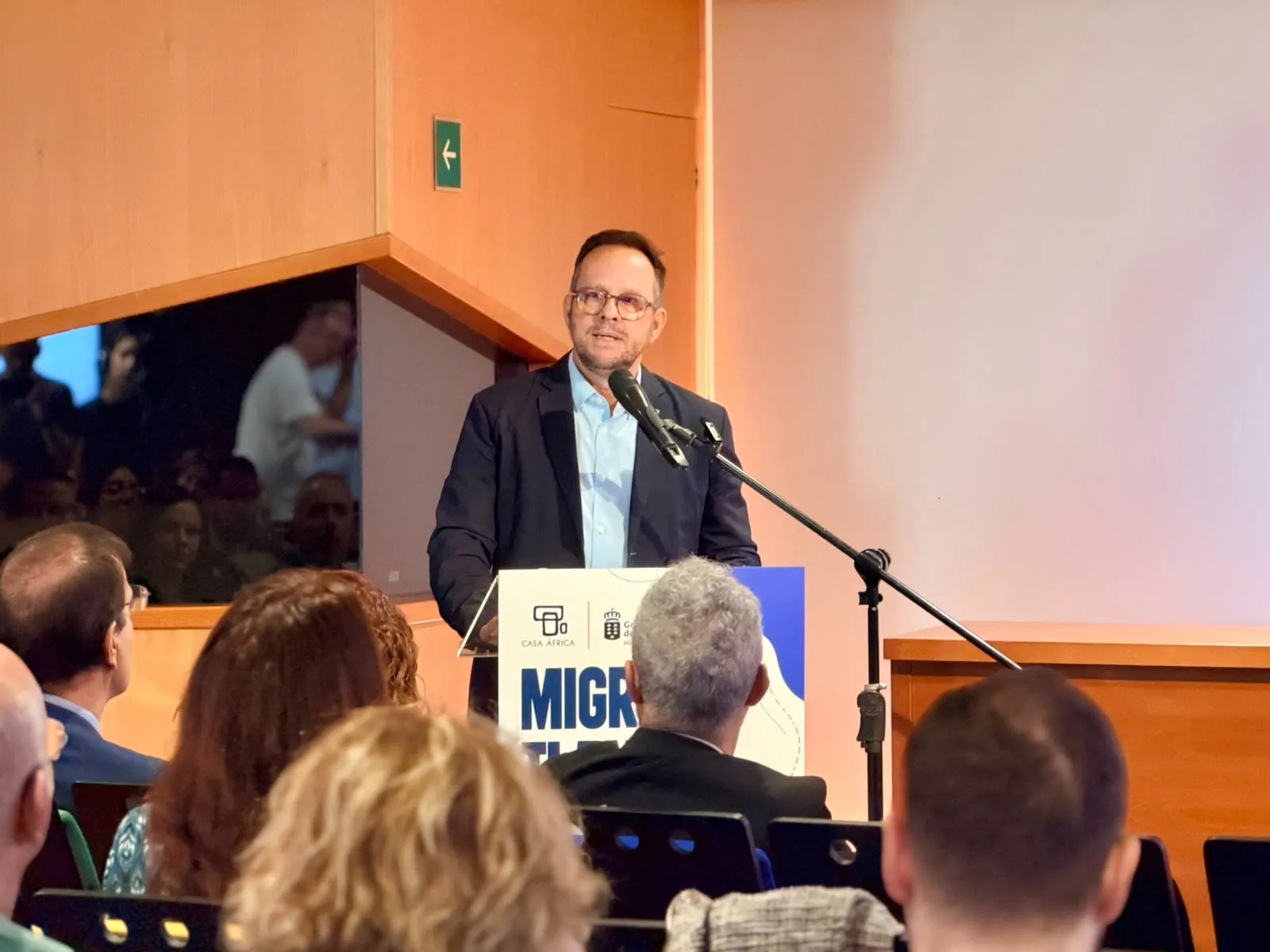
The Deputy Minister of the President's Cabinet, Octavio Caraballo, inaugurated the event, warning about the use of fear by some political parties against migration. He recalled the 20th anniversary of the 'cayucos' crisis and the current situation in El Hierro, describing it as "particularly delicate for our democratic coexistence".
Caraballo emphasized that "fear divides, fuels resentment, and weakens democracy," and debunked the idea that closing borders is a solution to migration. He pointed out that social networks often spread messages "that do not reflect reality, with no other purpose than to generate hatred and fear of the different," and stressed the importance of directly understanding the opinions of young people, who primarily get their information through these platforms.
José Segura, director of Casa África, alerted about the biased algorithms of social networks that "criminalize migrants" and "monetize indignation and rejection." The 5th edition of Migratlantes included workshops in Gran Canaria and Tenerife, organized by the Spanish Institute for Migration Analysis (IEAM) and Islas Responsables Lab (IRLab), where young people analyzed migratory disinformation and demanded greater involvement in decisions concerning them.
The workshops revealed concerns about the reliability of information and the difficulty in discerning trustworthy sources. Participants expressed their desire to be heard and to participate in decision-making, criticizing an "infantilizing" treatment and loss of autonomy. The importance of language as a barrier and the need for support after leaving detention centers were highlighted.
Access to formal employment and precariousness were also discussed, as well as the "weariness" of participants of African origin due to prejudice and automatic association with 'cayucos' arrivals. The executive director of IEAM, Beatriz de León, proposed measures to strengthen policies, youth autonomy, and coexistence, including coordination between administrations and the creation of common guidance and referral procedures.
Researcher Rut Bermejo opened the event by questioning whether perceptions of migration are changing, concluding that while public opinion is largely positive, specific impactful narratives can influence it. She proposed shifting from crisis management to a proactive policy with clear axes of integration and cooperation.
Subsequent roundtables, moderated by journalist Nicolás Castellano, analyzed restrictive discourses on migration among young people and the role of media in covering the issue, with participation from Silvia Caraballo, Sabina Civila, José Naranjo, and José María Rodríguez.