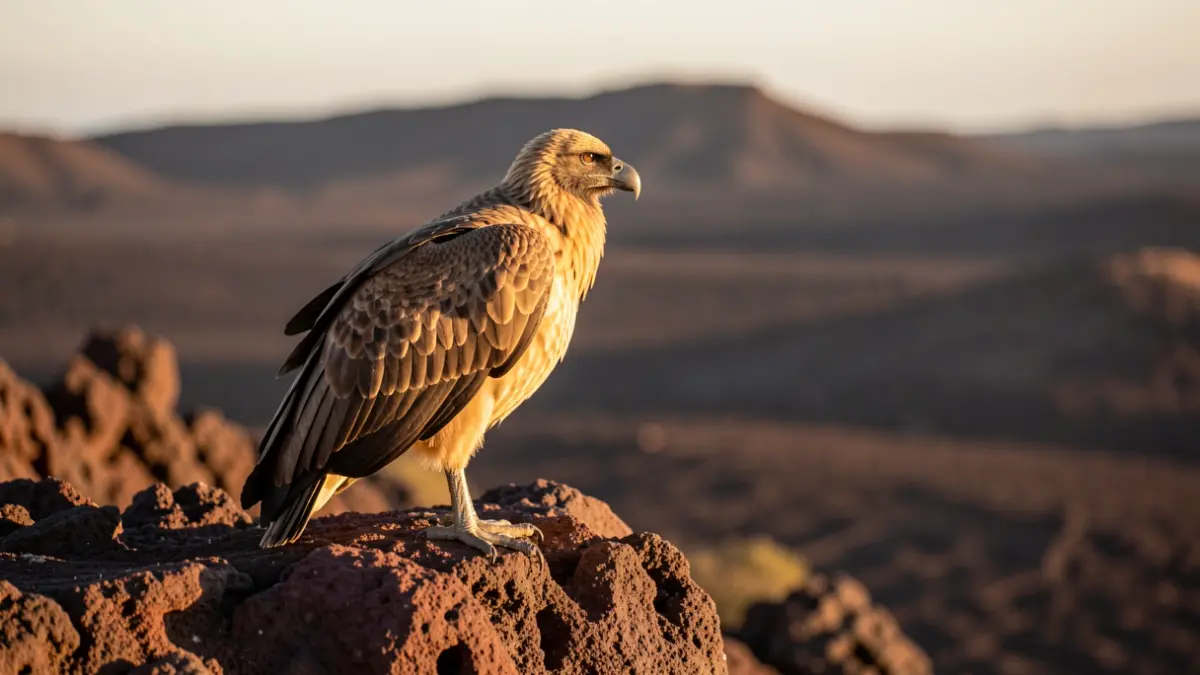
The species, which returned to Timanfaya in 2022, confirms its incipient recovery thanks to the same pair that nested in 2024. This achievement is part of the Monitoring Program promoted by the Directorate General of Natural Environment of the Government of the Canary Islands, with scientific advice from the Doñana Biological Station (CSIC).
The Canarian Egyptian vulture has overcome the critical danger of extinction, increasing its population from just over 70 to around 200 individuals in the last two decades. This growth has allowed it to colonize new territories, such as Lanzarote, an island neighboring Fuerteventura, where the recovery has been particularly visible.
According to field technician Walo Moreno, choosing the breeding cave, adding material to the nest, and reinforcing the pair bond through joint flights and frequent copulations are crucial in the early dates of the year. The incubation phase (42 days) and the first three weeks after hatching are particularly delicate.
Experts warn that noise, motorized vehicles, loose dogs, and other human activities can cause nest abandonment. The Government of the Canary Islands reminds the public of the importance of respecting signage, staying on marked trails, and enjoying nature in silence, especially during the nesting season.
“"This is excellent news for the Canary Islands and for the conservation of our biodiversity."
The Egyptian vulture, a subspecies unique to the archipelago (Neophron percnopterus majorensis), is the only strictly scavenger raptor in the Canarian fauna. Its genetic and morphological differentiation was described in 2002.