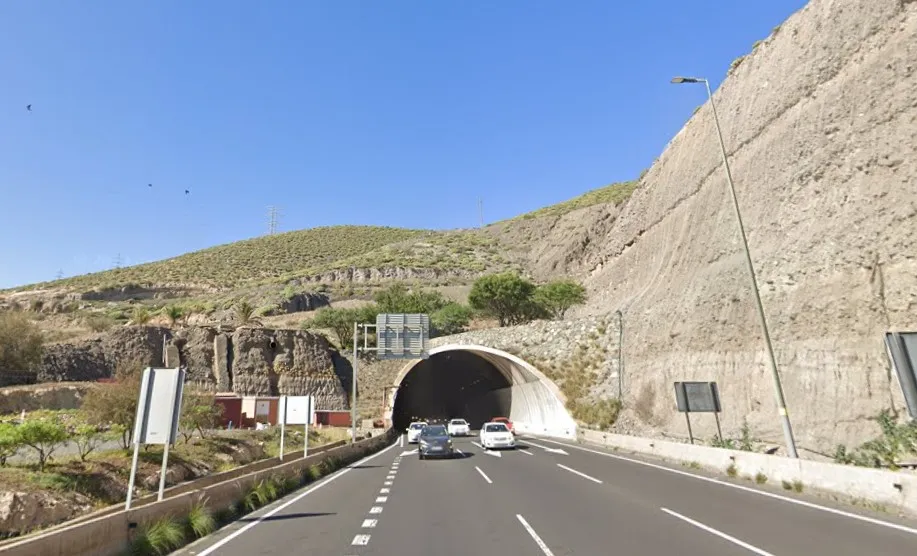
The Department of Public Works, Housing, and Mobility of the Government of the Canary Islands, through the General Directorate of Road Infrastructure, has awarded the contract for the adaptation to Directive 2004/54/EC of the Adolfo Cañas and Piedra Santa tunnels on the GC-1, in Gran Canaria, to the UTE formed by COMSA Instalaciones y Sistemas Industriales A.A.u, Nortunel S.A., and COMSA S.A.U. for a total amount of 8,915,909.97 euros, including IGIC.
The Canarian Executive aims to adapt the so-called La Laja tunnels to the safety standards required by European Directive 2004/54/EC, applicable to all tunnels over 500 meters integrated into the Trans-European Road Network. This regulation is mandatory for both new tunnels and those already in service, such as these infrastructures, which have been operational since 1999.
The project includes the construction of an evacuation gallery of approximately 774 meters with two pedestrian emergency exits for the Adolfo Cañas tunnel, as well as the installation of a water tank and a pump room for fire protection measures in the Piedra Santa tunnel. Furthermore, a comprehensive renovation of the energy, ventilation, and lighting systems of both tunnels is planned to ensure maximum road safety and improve the energy efficiency of these key infrastructures in the Canary Islands' road network.
The projected pedestrian gallery in the Adolfo Cañas tunnel will run along the seaward side, roughly parallel to the tunnel's alignment. It will feature a first emergency exit located 470 meters from the entrance and a second exit 390 meters from the exit, connected to allow self-evacuation of users trapped in case of fire. This measure enhances the tunnel's safety in case of failure of other systems (like ventilation, public address, etc.).
In the Adolfo Cañas tunnel, new power supply lines will be installed for ventilation equipment, lighting (including emergency), traffic management, SOS posts, section speed radar, and communication systems such as public address and radiant cable. Additionally, fire-resistant cabling will be incorporated to enhance safety in case of fire. For lighting, LED luminaires will be implemented for permanent, emergency, and safety lighting, complying with current regulations and reducing energy consumption. The ventilation system will also be updated with new environmental sensors, CO2 detectors, opacimeters, and anemometers, along with new cabling for the existing 14 fans.
The Piedra Santa tunnel will also feature new power lines for fire protection systems, traffic management, guidance lighting, and internal communication. A new generator set and fire-resistant cabling for all critical systems will be installed. The lighting will be completely renovated with high-efficiency LED technology. Regarding ventilation, two new reversible longitudinal fans will be installed, in addition to replacing the four current fans. All these devices will have new cabling for both power and communications.
These actions represent a firm step towards the modernization of the Archipelago's tunnels, aligning Canarian infrastructures with the highest technical and safety standards.