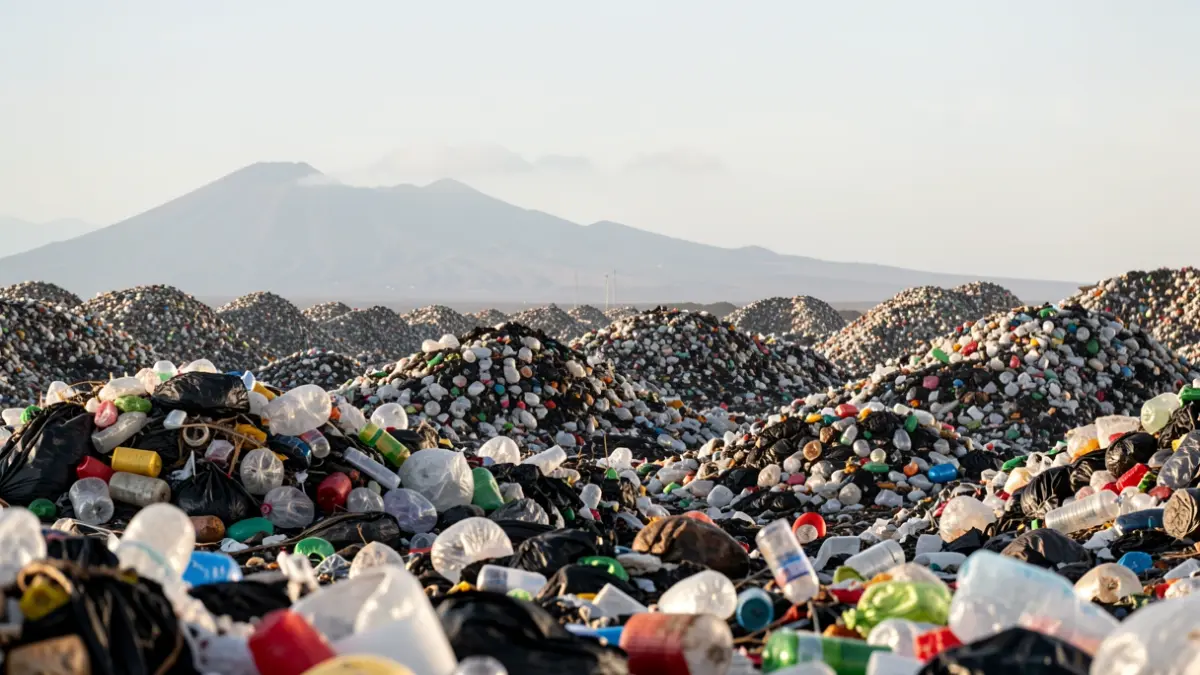
Experts and health authorities in the Canary Islands have issued a stark warning: the archipelago cannot continue relying on landfills for waste management. The annual accumulation of 1.2 million tons of waste, equivalent to filling the Gran Canaria Stadium in just six months, highlights an unsustainable model that consumes valuable land and creates significant environmental problems.
Faced with this crossroads, the need to adopt more efficient and sustainable management systems, similar to those already implemented in other autonomous communities and European countries like Belgium, Denmark, and Germany, is being raised. The installation of energy recovery plants, commonly known as incinerators, is emerging as a key solution. These facilities not only destroy waste without occupying additional space but also generate electrical and thermal energy, a more productive alternative than the current investment in geothermal energy.
The Law 7/2022 on waste and contaminated soils for a circular economy promotes the principles of self-sufficiency and proximity, principles that the Canary Islands currently fail to meet. The alternative of sending waste to other autonomous communities entails high economic costs for citizens and the risk of rejection, as has already occurred with Andalusia and asbestos.
A lack of long-term planning, administrative complexity with divided responsibilities among municipalities, island councils (cabildos), and the regional government, coupled with the political fear of making unpopular decisions, have contributed to the current 'ticking time bomb,' according to Carlos Medina, dean of the College of Industrial Engineers of Eastern Canary Islands. Social resistance to new projects and the proximity of elections exacerbate the paralysis, leading to inaction that harms the future of the islands.
Currently, only 9% of the waste generated in the Canary Islands is recycled, while the remaining 91% ends up buried in landfills organized into cells. These facilities, managed by the cabildos, are at their capacity limit. In Gran Canaria, the Salto del Negro landfill has capacity until the end of 2028, and Juan Grande until mid-2029. Similar situations are found in Lanzarote (Zonzamas), La Palma (Los Morenos), La Gomera (El Revolcadero), El Hierro (La Dehesa), and Tenerife (Arico).
Several consulted sources suggest the creation of at least two incinerator plants on the main islands. Tenerife leads waste generation with 41.4% of the total, followed by Gran Canaria with 36.56%. The opposition of some islands to receive waste from others, such as Tenerife regarding El Hierro, further complicates the search for solutions.
The Department of Ecological Transition has initiated the process to study the technical and economic feasibility of installing an energy recovery plant in Gran Canaria, with an initial investment of 15,000 euros for a preliminary study. Subsequently, a similar contract is planned for Tenerife. These studies will analyze at least two viable locations on each island, seeking the most suitable alternative from technical, environmental, urban planning, and administrative perspectives, despite the initial lack of consensus with the cabildos.