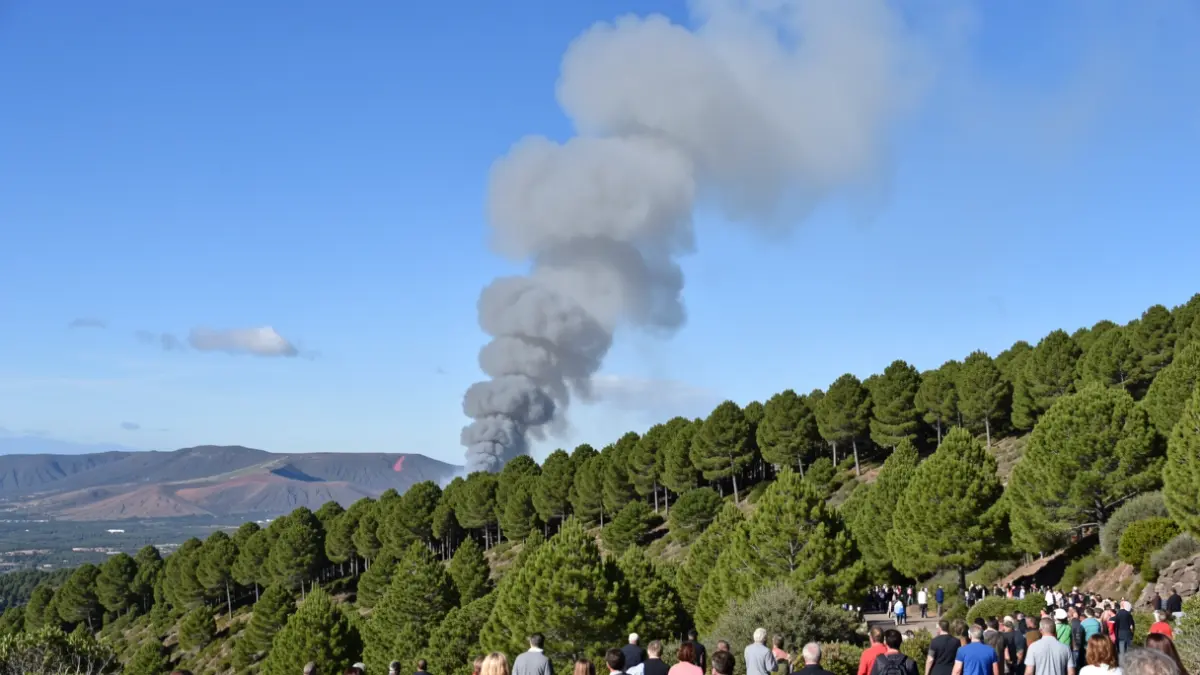
The forest fires in Madrid and Ávila, which have already consumed 20,000 hectares and affect over 88,000 people, are exhibiting unusual behavior, generating their own wind currents and abruptly changing direction. Experts warn that these fires, exacerbated by climate change and land abandonment, are more difficult to extinguish than to prevent.
Given the scale of the problem, which transcends municipalities and autonomous communities, the Cabildo of Gran Canaria has made specialized personnel available in areas of air coordination, intervention, analysis, communications, surveillance, and technical support. "When Gran Canaria needed help to put out the fires that occurred on our island, we received it," explained the insular president.
Federico Grillo, insular director of Emergencies for Gran Canaria, describes these fires as 'hungry' and difficult to extinguish due to their intensity and the large convective columns they generate. The projection of smoke and ash, along with the appearance of 'secondary fires ahead,' complicates any extinction strategy, forcing operatives to 'retreat and entrench' in agricultural and urban areas, which are often neglected.
The European Commission has mobilized four Canadair aircraft from Greece and Italy, and the Spanish government activated the European Civil Protection Mechanism to request more resources. Andalusia, Extremadura, and the Valencian Community have also offered assistance, along with support from the Portuguese Army.
Grillo emphasizes that the solution lies not only in the quantity of resources or the quality of inter-institutional networks but in year-round prevention. "It's like having many accidents and offering many ambulances as a solution, but not addressing the root problem," he compares, pointing to fuel load and extreme weather conditions as key factors.