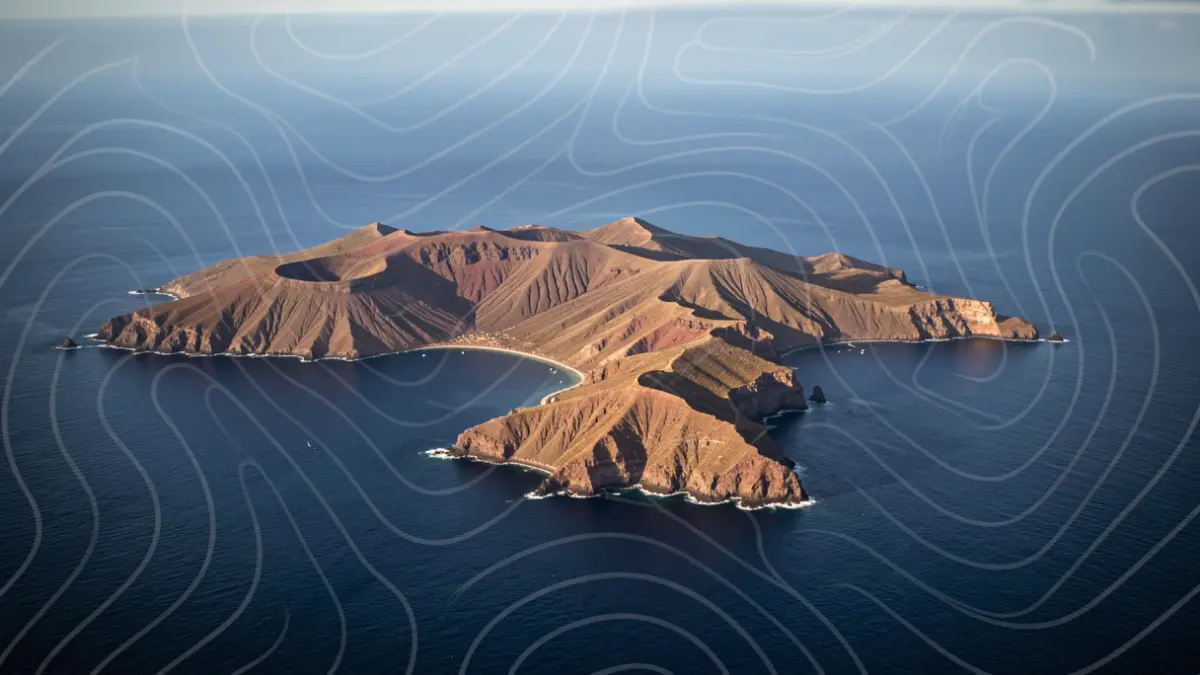
The earth reminded the Canary Islands of its seismic nature with a magnitude 4.8 tremor, the most significant earthquake near Gran Canaria in the last 37 years. The seismic event occurred at 9:50 AM in the Atlantic Ocean, 61 kilometers north of Las Palmas de Gran Canaria and at a depth of 30 kilometers.
The event, which had its epicenter in a low-seismicity zone, was strongly felt across much of Gran Canaria, as well as in Tenerife and Fuerteventura. The National Geographic Institute (IGN) has classified it as the most powerful seismic event detected in the archipelago since the 2021 volcanic eruption on La Palma, which reached a magnitude of 5.1.
The vibration was clearly perceived by the population, triggering a wave of communications on social media. In Gran Canaria, the intensity reached level III in several municipalities, from Maspalomas to La Aldea de San Nicolás, causing objects to sway and noises to be heard. In Tenerife and Fuerteventura, the perception was lesser (level II), with a slight swaying felt.
“"It is the earthquake of the highest magnitude we have registered in the Canary Islands since the eruption of La Palma. In El Hierro and La Palma, we have had significant episodes in recent years, but between Tenerife and Gran Canaria, we would have to go back quite a bit to find something comparable."
The director of the IGN in the Canary Islands, Itahiza Domínguez, noted that while the Canary Islands are a seismic zone, an earthquake of this magnitude in that specific area is unusual. He recalled precedents such as a magnitude 5.3 earthquake in 1989 between Tenerife and Gran Canaria, and a 4.9 tremor in 1998 east of Fuerteventura, emphasizing that the area of the recent tremor is not typically very active.
Following the main shock, several aftershocks were recorded, a phenomenon considered normal. The IGN maintains active seismic monitoring with no current indications of risk to the population. Scientists almost completely rule out a connection to volcanic activity, as this is usually preceded by seismic swarms, not a single strong earthquake.
The most probable hypothesis points to tectonic causes. The Canary Islands are situated in a complex geological zone where structures associated with the Atlantic oceanic plate and the African continental margin interact. Differential movements in these plates could explain seismic events of considerable magnitude in unusual areas, about which scientific knowledge, especially regarding underwater structures, remains limited.