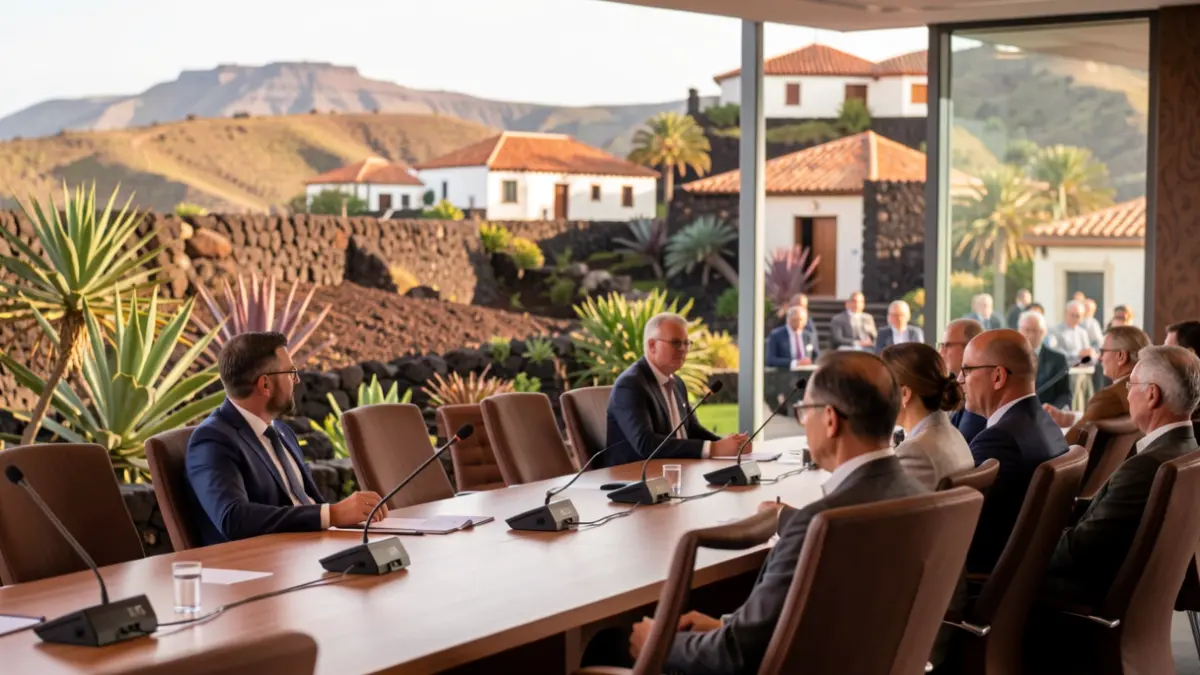
The President of the Cabildo of Gran Canaria, Antonio Morales, has defended the institution's management during his eleven years at the helm, addressing various current issues and strategic projects for the island in an interview. Morales described the debate on the state of the island as a necessary democratic exercise to present positions and analyze the real situation, rejecting demagoguery and polarization.
Regarding the housing crisis, Morales pointed out that the primary responsibility lies with the Government of the Canary Islands, although the Cabildo collaborates on rehabilitation. He criticized the existence of 211,000 empty homes on the island and the actions of vulture funds, advocating for a deep analysis of the model and rent regulation, rather than focusing solely on building new homes.
In the socio-health sector, he highlighted that the Cabildo is the only one that has executed its own socio-health plan and built centers, even though this is a regional competence. He noted the need to continue increasing places due to the aging population and to create structures for home care.
On mobility, he indicated that work is underway on the future concession for interurban transport, considering the option of a public company, and legal reports are being gathered to make a decision.
In tourism, Morales supported the implementation of a tourist tax, criticizing the Government of the Canary Islands for yielding to sectoral pressures. He advocated for coordinating measures between islands and called for a tourism moratorium that limits construction to already urbanized land.
He also addressed the controversial ruling that annulled the Insular Planning Plan (PIO), calling it erroneous and unjust, and expressed confidence that the Supreme Court will overturn the decision. He assured that, in the worst-case scenario, they would revert to the 2004 plan but insisted on the robustness of the current document.
The president defended the Salto de Chira project as a model for sustainable development and energy security, despite criticism from a minority. He also detailed the system adaptation phase for the extension to the Las Niñas reservoir.
Regarding the Gran Canaria Stadium, he acknowledged the unpredictability of cost overruns in public works but noted that savings are being studied and that the involvement of private capital is speeding up financing. The work has been tendered and is expected to begin this year.
On the subject of the train, Morales expressed confidence in obtaining European and Spanish funding, lamenting that the Spanish Government's difficulty in approving budgets is hindering investment.
Regarding the Gran Canaria Basketball Club, he reiterated the Cabildo's intention to sell its ownership, criticizing public involvement in sports club management and lamenting the lack of greater involvement from local businesses. He categorically denied any conversations with Miguel Ángel Ramírez, president of UD Las Palmas, about a potential acquisition.
Finally, he announced that the resolution of the appeal regarding the new Infecar pavilion is expected within weeks, and highlighted the upcoming opening of the Museum of Fine Arts of Gran Canaria as a cultural boost and for the island's projection as a European cultural capital.