The imminent visit of Pope Leo XIV to the Canary Islands marks a historic milestone, being the first time a pontiff sets foot on Canarian soil. For this world-scale event, architect Jorge Cerpa and technical coordinator Rafael Suárez have been tasked with designing the stages, aiming to merge religious sentiment with the island's identity. The key locations for mass celebrations will be the Estadio de Gran Canaria and the port of Arguineguín.
Precise directives have come from the Vatican regarding altar dimensions, stage proportions, and basic liturgical needs. The presence of the Swiss Guard and security officials has been crucial in defining every detail, prioritizing safety and clarity of the environment for the pontiff, who travels constantly and requires immediate recognition of spaces.
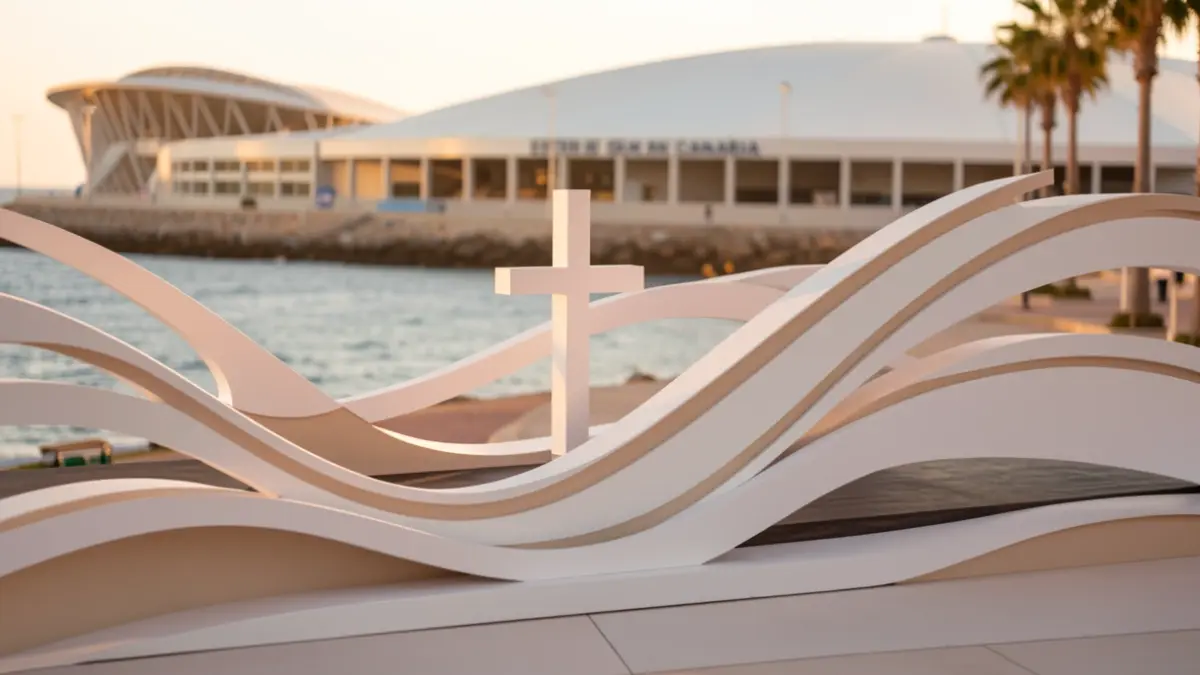
The design of both stages shares a common language, strongly influenced by the sea, alluding to the migratory phenomenon in the Canary Islands. Cerpa has employed curved and organic shapes to convey welcome and hope, symbolically connecting with biblical passages of storms and the uncertainty of those arriving on the islands. In Arguineguín, the stage adopts the form of a wave, integrating with the real environment of the sea and the pier.
The assembly at the Estadio de Gran Canaria presents an additional challenge due to the uncertainty of the sports calendar, requiring construction within just 24 hours. Tubular structures and aluminum modules will be used to speed up assembly. The stage backdrop will include arches representing the apostles, with the altar as the central axis, flanked by the images of Cristo de Telde and the Virgen del Pino.
The greatest challenge will be the final assembly, where precision will be key. Despite the ephemeral nature of the structures, their architectural and symbolic impact will endure, serving as a support for a message of hope in the face of uncertainty.